


Page 39 - FDMAsia MarApr 2025
P. 39
TECHNOLOGY           37
         www.fdmasia.com | FDM ASIA MAR/APR 2025


          of all stages of the product life cycle.
            Therefore, for an adequate transition towards the Circular
          Economy (CE), public and private managers need to make
          assertive decisions about waste management.

            Within this context, the wood waste from the furniture
          industry is a material that deserves special attention, considering
          that it is still relatively unexplored in manufacturing industries,
          despite the existence of many proven studies guaranteeing a
          wide portfolio of products for incorporating said material as
          a raw material. This unexpressive use occurs mainly due to   stakeholders must be guided on the best ways to dispose
          the lack of efficiency in classifying these materials.   of the wood waste from the furniture industry. This can be
            In Brazil, the vast majority of furniture industries utilise this   accomplished through guidelines, strategies, and goals to
          wood waste either by burning it in ovens for heat and energy   achieve an adequate management towards the CE.

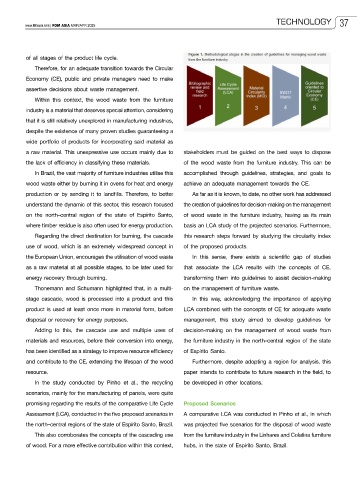
          production or by sending it to landfills. Therefore, to better   As far as it is known, to date, no other work has addressed
          understand the dynamic of this sector, this research focused   the creation of guidelines for decision-making on the management
          on the north–central region of the state of Espírito Santo,   of wood waste in the furniture industry, having as its main
          where timber residue is also often used for energy production.  basis an LCA study of the projected scenarios. Furthermore,
            Regarding the direct destination for burning, the cascade   this research steps forward by studying the circularity index
          use of wood, which is an extremely widespread concept in   of the proposed products.
          the European Union, encourages the utilisation of wood waste   In  this sense,  there  exists  a  scientific  gap  of  studies

          as a raw material at all possible stages, to be later used for   that associate the LCA results with the concepts of CE,
          energy recovery through burning.                   transforming them into guidelines to assist decision-making
            Thonemann and Schumann highlighted that, in a multi-  on the management of furniture waste.
          stage cascade,  wood  is  processed  into  a product  and  this   In this way, acknowledging the importance of applying
          product is used at least once more in material form, before   LCA combined with the concepts of CE for adequate waste
          disposal or recovery for energy purposes.          management, this study aimed to develop guidelines for
            Adding  to  this,  the  cascade  use  and  multiple  uses  of   decision-making on the management of wood waste from
          materials and resources, before their conversion into energy,   the furniture industry in the north–central region of the state
          has been identified as a strategy to improve resource efficiency   of Espírito Santo.

          and contribute to the CE, extending the lifespan of the wood   Furthermore, despite adopting a region for analysis, this
          resource.                                          paper intends to contribute to future research in the field, to
            In the study conducted by Pinho et al., the recycling   be developed in other locations.
          scenarios, mainly for the manufacturing of panels, were quite
          promising regarding the results of the comparative Life Cycle   Proposed Scenarios
          Assessment (LCA), conducted in the five proposed scenarios in   A comparative LCA was conducted in Pinho et al., in which
          the north–central regions of the state of Espírito Santo, Brazil.   was projected five scenarios for the disposal of wood waste

            This also corroborates the concepts of the cascading use   from the furniture industry in the Linhares and Colatina furniture
          of wood. For a more effective contribution within this context,   hubs, in the state of Espírito Santo, Brazil.

