


Page 36 - FDMAsia MarApr 2025
P. 36
34   TECHNOLOGY                                                                   MAR/APR 2025 FDM ASIA | www.fdmasia.com


                                                                Conversely, less visual attention is given to chairs with
                                                             lower ratings that they dislike less, thus inducing smaller pupil
                                                             diameters in the first fixation duration.
                                                                Guo et al. proved that saccade and fixation counts relate

                                                             to users’ emotional experiences when shopping online. Other
                                                             studies have shown that the type of traditional furniture has
                                                             a significant effect on total fixation time and average fixation
                                                             count.
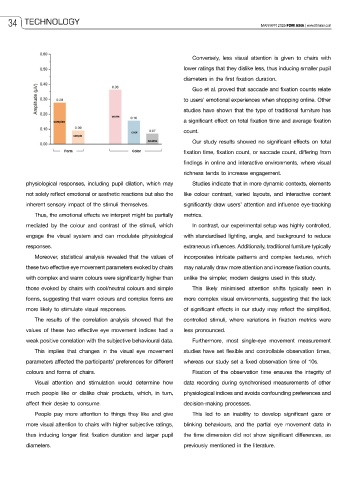
                                                                Our study results showed no significant effects on total
                                                             fixation time, fixation count, or saccade count, differing from
                                                             findings in online and interactive environments, where visual
                                                             richness tends to increase engagement.
          physiological  responses,  including  pupil  dilation,  which  may   Studies indicate that in more dynamic contexts, elements

          not solely reflect emotional or aesthetic reactions but also the   like colour contrast, varied layouts, and interactive content
          inherent sensory impact of the stimuli themselves.   significantly draw users’ attention and influence eye-tracking
            Thus, the emotional effects we interpret might be partially   metrics.
          mediated by the colour and contrast of the stimuli, which   In contrast, our experimental setup was highly controlled,
          engage the  visual system and can modulate physiological   with standardised lighting, angle, and background to reduce
          responses.                                         extraneous influences. Additionally, traditional furniture typically
            Moreover, statistical analysis revealed that the values of   incorporates intricate patterns and complex textures, which

          these two effective eye movement parameters evoked by chairs   may naturally draw more attention and increase fixation counts,
          with complex and warm colours were significantly higher than   unlike the simpler, modern designs used in this study.
          those evoked by chairs with cool/neutral colours and simple   This likely minimised attention shifts  typically seen in
          forms, suggesting that warm colours and complex forms are   more complex visual environments, suggesting that the lack
          more likely to stimulate visual responses.         of significant effects in our study may reflect the simplified,
            The  results  of  the  correlation  analysis  showed  that  the   controlled  stimuli,  where  variations  in fixation metrics  were
          values of these two effective eye movement indices had a   less pronounced.
          weak positive correlation with the subjective behavioural data.   Furthermore,  most  single-eye  movement  measurement
            This implies that changes in the visual eye movement   studies have set flexible and controllable observation times,

          parameters affected the participants’ preferences for different   whereas our study set a fixed observation time of 10s.
          colours and forms of chairs.                          Fixation of the observation time ensures the integrity of
            Visual attention and stimulation would determine how   data recording during synchronised measurements of other
          much people like or dislike chair products, which, in turn,   physiological indices and avoids confounding preferences and
          affect their desire to consume.                    decision-making processes.
            People pay more attention to things they like and give   This led to an inability to develop significant gaze or
          more visual attention to chairs with higher subjective ratings,   blinking behaviours, and the partial eye movement data in

          thus inducing longer  first  fixation duration and  larger pupil   the time dimension did not show significant differences, as
          diameters.                                         previously mentioned in the literature.

