


Page 41 - FDMAsia MarApr 2025
P. 41
TECHNOLOGY           39
         www.fdmasia.com | FDM ASIA MAR/APR 2025


          LCA & MCI Results                                     Upon completing the diagnosis, the scenarios were
          The results of the study by Pinho et al., presented below,   analysed in light of the strengths, weaknesses, opportunities,
          serve as the primary reference for preparing the SWOT matrix.   and threats identified in the matrix quadrants.
          Subsequently, the results from the Global Warming (GW)   It is possible to observe that the strengths listed positively

          category were adopted as a reference to continue the analyses.   influence the panel industry in the redesign of the MDF
            Considering the concept of the cascading use of wood,   produced, making it more eco-efficient product. Thus, the
          prioritising use scenarios for manufacturing products is essential,   MDF was improved with the proposal to include 20 percent
          with disposal for burning reserved as an end-of-life option.  w/w of wood waste, replacing a percentage of virgin sources.
            The  results  of  the  sensitivity  analysis  regarding  waste   It was possible  to  reduce the use of urea  formaldehyde
          transport distances were also significant for this study. It   resin (UF) from 14 percent to 13.5 percent of the total weight
          demonstrates the feasibility of utilising waste from the furniture   of the board, influencing the reduction in environmental
          industry throughout Grande Vitória.                loads. In relation to MDP, corporative forces encourage the
            Only the truck modal from the southern region appears to   company to include it in its product portfolio, since the panel

          be environmentally unviable. The modals that integrate trains   factory in the state of Espírito Santo, Brazil, has its production
          and trucks show promise in all studied regions.    concentrated on the manufacture of MDF.
            Furthermore, considering that the amount of waste required   Within the study analysed, MDP incorporates 20 percent
          to meet the monthly production of the projected scenarios   w/w of wood waste in its composition, making the panel more
          and the estimated monthly generation of wood waste (6700   environmentally friendly, this being a practice that does not
          tonnes) in the furniture hubs of Colatina and Linhares, more   require a complex process for recycling.
          than one scenario could be addressed simultaneously; however,   In addition to the region studied, the sensitivity analysis

          the amount of wood waste is sensitive to market demands.  proved that all panel manufacturing can also receive waste
            In addition to the LCA study, this article also considers   from the entire Metropolitan Region of Grande Vitória. The
          the calculations of the circularity index (MCI) and the product   proposed redesign aimed to enhance the eco-efficiency of
          linearity index (LFI). Bertani et al. highlighted the importance   the panels, resulting in environmental benefits compared to
          of joining MCI with LCA in search of circular and sustainable   products manufactured solely with wood from virgin sources.
          solutions.
            LCA is a consolidated methodology that follows ISO
          standards,  allowing  for  the  study  of  the  entire  product  life
          cycle and obtaining information on different impact categories

          at different stages of the life cycle, whereas, for the MCI,
          information about the origin of  the raw material, lifespan,
          function, and destination after use is necessary. Another feature
          of MCI is to present the result in a single value.


          SWOT Matrix Results
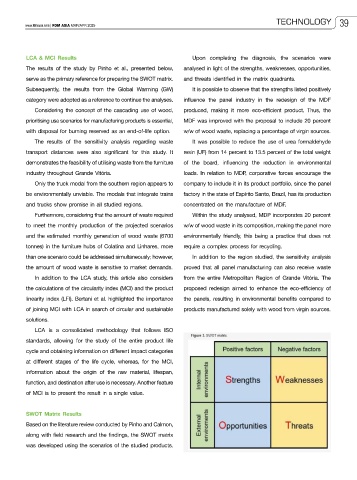
          Based on the literature review conducted by Pinho and Calmon,

          along with field research and the findings, the SWOT matrix
          was developed using the scenarios of the studied products.

