


Page 43 - FDMAsia MarApr 2025
P. 43
TECHNOLOGY           41
         www.fdmasia.com | FDM ASIA MAR/APR 2025


            Opportunities are external factors that can positively   (WW from virgin wood) and panels (WW from wood panels)
          stimulate the industry in the decision to improve the existing   to landfill
          product in its portfolio.                          •  Guideline 2—Encourage the use of WW based on the
            The selection and sorting of wood waste (WW) must be   concept of industrial symbiosis

          improved, generating added value and transforming waste into   •  Guideline 3—Promote the creation of a market for the use
          raw material for the ceramic industry, which will also lead to   of WW as a raw material in new products, such as MDF,
          the qualification of labour. This proposed scenario is also in   MDP, and ceramic brick
          line with the concept of industrial symbiosis.
            Additionally, the network platform for monitoring the quantity   The first step expressed in Guideline 1 would be to inhibit
          of available WW will allow the ceramic industry to schedule   the disposal of virgin wood waste and wood panel waste to
          its production with existing WW. In this context, there is a   landfill, as classified by Pinho et al.
          broad field for leveraging new sustainable business models.  The strengths and opportunities detected for the manufacture
            Threats are external variables that can create difficulties   of products in Scenarios 1, 2, and 3 show promising scenarios

          in implementing improvements to be made to the product by   for the allocation of WW, which justifies the first guideline.
          the red ceramic industry, which are essentially similar to the   Given its availability for disposal as a raw material, it is
          challenges highlighted in the panel industries.    necessary to encourage the use of WW based on the concept
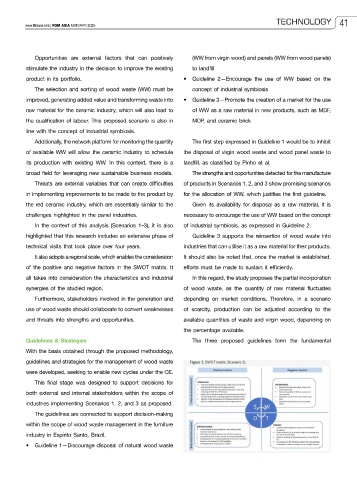
            In the context of this analysis (Scenarios 1–3), it is also   of industrial symbiosis, as expressed in Guideline 2.
          highlighted that this research includes an extensive phase of   Guideline 3 supports the reinsertion of wood waste into
          technical visits that took place over four years.   industries that can utilise it as a raw material for their products.
            It also adopts a regional scale, which enables the consideration   It should also be noted that, once the market is established,

          of the positive and negative factors in the SWOT matrix. It   efforts must be made to sustain it efficiently.
          all takes into consideration the characteristics and industrial   In this regard, the study proposes the partial incorporation
          synergies of the studied region.                   of wood waste, as the quantity of raw material fluctuates
            Furthermore, stakeholders involved in the generation and   depending on market conditions. Therefore, in a scenario
          use of wood waste should collaborate to convert weaknesses   of scarcity, production can be adjusted according to the
          and threats into strengths and opportunities.      available quantities of waste and virgin wood, depending on
                                                             the percentage available.
          Guidelines & Strategies                               The three proposed guidelines form the fundamental
          With the basis obtained through the proposed methodology,

          guidelines and strategies for the management of wood waste
          were developed, seeking to enable new cycles under the CE.
            This  final  stage  was  designed  to  support  decisions  for
          both external and internal stakeholders within the scope of
          industries implementing Scenarios 1, 2, and 3 as proposed.
            The guidelines are connected to support decision-making
          within the scope of wood waste management in the furniture

          industry in Espírito Santo, Brazil.
          •  Guideline 1—Discourage disposal of natural wood waste

