


Page 44 - FDMAsia MarApr 2025
P. 44
42   TECHNOLOGY                                                                   MAR/APR 2025 FDM ASIA | www.fdmasia.com


                                                             waste in new cycles, a stock of raw material will be available for
                                                             use in industry. In this way, Guideline 2 advances, encouraging
                                                             connections between industries.


                                                             Guideline 2
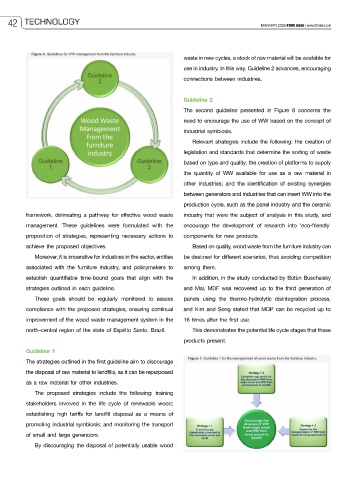
                                                             The second guideline presented in Figure 8 concerns the
                                                             need to encourage the use of WW based on the concept of
                                                             industrial symbiosis.
                                                                Relevant strategies include the following: the creation of
                                                             legislation and standards that determine the sorting of waste
                                                             based on type and quality; the creation of platforms to supply
                                                             the  quantity  of  WW  available  for  use  as  a  raw  material  in
                                                             other industries; and the identification of existing synergies

                                                             between generators and industries that can insert WW into the
                                                             production cycle, such as the panel industry and the ceramic
          framework, delineating a pathway for effective wood  waste   industry  that were the subject  of  analysis  in  this  study, and
          management. These guidelines were formulated with the   encourage the development of research into ‘eco-friendly’
          proposition of strategies, representing necessary actions to   components for new products.
          achieve the proposed objectives.                      Based on quality, wood waste from the furniture industry can
            Moreover, it is imperative for industries in the sector, entities   be destined for different scenarios, thus avoiding competition

          associated with  the furniture industry,  and policymakers to   among them.
          establish quantifiable time-bound goals that align with the   In addition, in the study conducted by Bütün Buschalsky
          strategies outlined in each guideline.             and Mai, MDF was recovered up to the third generation of
            These  goals  should  be  regularly  monitored  to  assess   panels using the thermo-hydrolytic disintegration process,
          compliance with the proposed strategies, ensuring continual   and Kim and Song stated that MDP can be recycled up to
          improvement of the wood waste management system in the   16 times after the first use.
          north–central region of the state of Espírito Santo, Brazil.  This demonstrates the potential life cycle stages that these
                                                             products present.
          Guideline 1

          The strategies outlined in the first guideline aim to discourage
          the disposal of raw material to landfills, as it can be repurposed
          as a raw material for other industries.
            The proposed strategies include the following: training
          stakeholders involved in the life cycle of renewable wood;
          establishing high tariffs for landfill disposal as a means of
          promoting industrial symbiosis; and monitoring the transport

          of small and large generators.
            By discouraging the disposal of potentially usable wood

