


Page 40 - FDMAsia MarApr 2025
P. 40
38   TECHNOLOGY                                                                   MAR/APR 2025 FDM ASIA | www.fdmasia.com


                                                             extent to which the linear flow is reduced and the restorative
                                                             flow is maximised for the materials comprising it.
                                                                It also considers the duration and intensity of its use
                                                             compared to similar products manufactured on an industrial

                                                             scale.
                                                                The MCI was utilised to quantify the circularity of the
                                                             proposed products in Scenarios 1, 2, and 3. The MCI
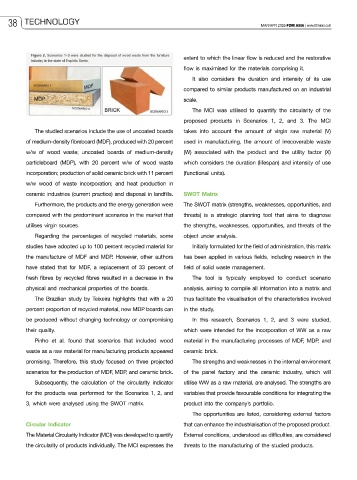
            The studied scenarios include the use of uncoated boards   takes into account the amount of virgin raw material (V)
          of medium-density fibreboard (MDF), produced with 20 percent   used in manufacturing, the amount of irrecoverable waste
          w/w of wood waste; uncoated boards of medium-density   (W) associated with the product and the utility factor (X)
          particleboard (MDP), with 20 percent w/w of wood waste   which considers the duration (lifespan) and intensity of use
          incorporation; production of solid ceramic brick with 11 percent   (functional units).
          w/w wood of waste incorporation; and heat production  in

          ceramic industries (current practice) and disposal in landfills.   SWOT Matrix
            Furthermore, the products and the energy generation were   The SWOT matrix (strengths, weaknesses, opportunities, and
          compared with the predominant scenarios in the market that   threats) is a strategic planning tool that aims to diagnose
          utilises virgin sources.                           the strengths, weaknesses, opportunities, and threats of the
            Regarding the percentages of recycled materials, some   object under analysis.
          studies have adopted up to 100 percent recycled material for   Initially formulated for the field of administration, this matrix
          the manufacture of MDF and MDP. However, other authors   has been applied in various fields, including research in the

          have stated that for MDF, a replacement of 33 percent of   field of solid waste management.
          fresh fibres by recycled fibres resulted in a decrease in the   The tool is typically employed to conduct scenario
          physical and mechanical properties of the boards.   analysis, aiming to compile all information into a matrix and
            The Brazilian study by Teixeira highlights that with a 20   thus facilitate the visualisation of the characteristics involved
          percent proportion of recycled material, new MDP boards can   in the study.
          be produced without changing technology or compromising   In this research, Scenarios 1, 2, and 3 were studied,
          their quality.                                     which were intended for the incorporation of WW as a raw
            Pinho et al. found that scenarios that included wood   material in the manufacturing processes of MDF, MDP, and
          waste as a raw material for manufacturing products appeared   ceramic brick.

          promising. Therefore, this study focused on three projected   The strengths and weaknesses in the internal environment
          scenarios for the production of MDF, MDP, and ceramic brick.   of the panel factory and the ceramic industry, which will
            Subsequently, the calculation of the circularity indicator   utilise WW as a raw material, are analysed. The strengths are
          for the products was performed for the Scenarios 1, 2, and   variables that provide favourable conditions for integrating the
          3, which were analysed using the SWOT matrix.      product into the company’s portfolio.
                                                                The opportunities are listed, considering external factors
          Circular Indicator                                 that can enhance the industrialisation of the proposed product.

          The Material Circularity Indicator (MCI) was developed to quantify   External conditions, understood as difficulties, are considered
          the circularity of products individually. The MCI expresses the   threats to the manufacturing of the studied products.

