


Page 35 - FDMAsia MarApr 2025
P. 35
TECHNOLOGY           33
         www.fdmasia.com | FDM ASIA MAR/APR 2025


          (5,  35) = 1.105,  p = 0.035 < 0.05,  ηp2 = 1.227),  whereas  form   difference in subjective evaluation scores, suggesting whether
          (p = 0.225 > 0.05)  and  interaction  (p = 0.217 > 0.05)  had  no   participants had a design-related education affected their
          significant effect.                                preference for chairs.
                                                                No significant sex-based differences were found, consistent

          Correlation Analysis                               with previous studies that reported no significant differences
          Based on the above results, we chose only different metrics   between men and women in terms of preferences.
          to determine whether eye movement, physiological responses,
          or EEG signals could reflect furniture aesthetics.   Multimodal Measurement Results
            This study conducted a correlation analysis between subjective   Visual fixation is active when assessing internal mental
          and objective data. Defining the nine-level evaluation scores   representations,  and  eye  movement  indicators  can  be used
          as Ordinal Data, all data were processed using Spearman’s   as measures of choice and preference.
          correlation inspection and the Kendall correlation coefficient test.   Based on data analysis, it was concluded that among
            The results suggest a weak positive correlation between   the five eye movement parameters, only the average pupil

          the subjective evaluation score, average pupil diameter   diameter and first fixation duration were significant and
          (Kendall’s tau-b = 0.044, p = 0.020 < 0.05; Spearman’s rho = 0.060,   effective. The chair colour significantly affected the average
          p = 0.023 < 0.05), and first fixation duration (Kendall’s tau-b = 0.045,   pupil diameter, whereas the interaction between chair colour
          p = 0.022 < 0.05;  Spearman’s  rho = 0.060,  p = 0.023 < 0.05).   and form significantly affected the first fixation duration.
          However,  there was no correlation between  the  subjective   In previous studies, there was little research on the form
          evaluation score and the SC signal (Kendall’s tau-b = 0.016,   and colour of furniture. However, there are references in other
          p = 0.404 > 0.05;  Spearman’s  rho = 0.022,  p = 0.411 > 0.05)  or   design fields. Bradley et al. found that pupil sizes evoked by

          the  P300  amplitude  (Kendall’s  tau-b = 0.038,  p = 0.327 > 0.05;   International Affective Picture System images differed significantly.
          Spearman’s rho = 0.057, p = 0.334 > 0.05).            Guo, Ding, Liu, Liu, and Zhang reported that first fixation
            The results were consistent, although the correlation   duration and average pupil diameter could reflect the user
          coefficients differed.                             experience of products when participants browse products freely.
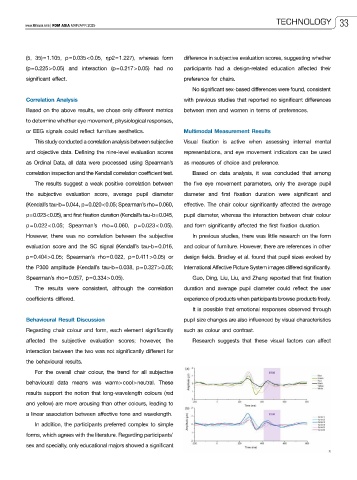
                                                                It is possible that emotional responses observed through
          Behavioural Result Discussion                      pupil size changes are also influenced by visual characteristics
          Regarding chair colour and form, each element significantly   such as colour and contrast.
          affected the subjective evaluation scores; however, the   Research suggests that these visual factors can affect
          interaction between the two was not significantly different for

          the behavioural results.
            For the overall chair colour, the trend for all subjective
          behavioural data means was warm > cool > neutral. These
          results support the notion that long-wavelength colours (red
          and yellow) are more arousing than other colours, leading to
          a linear association between affective tone and wavelength.
            In addition, the participants preferred complex to simple

          forms, which agrees with the literature. Regarding participants’
          sex and specialty, only educational majors showed a significant

