


Page 30 - FDMAsia MarApr 2025
P. 30
28   TECHNOLOGY                                                                   MAR/APR 2025 FDM ASIA | www.fdmasia.com


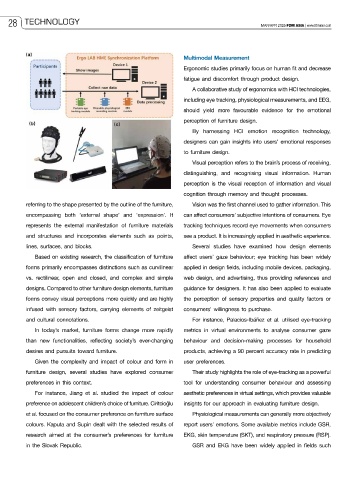
                                                             Multimodal Measurement
                                                             Ergonomic studies primarily focus on human fit and decrease
                                                             fatigue and discomfort through product design.
                                                                A collaborative study of ergonomics with HCI technologies,

                                                             including eye tracking, physiological measurements, and EEG,
                                                             should yield more favourable evidence for the emotional
                                                             perception of furniture design.
                                                                By harnessing HCI emotion recognition technology,
                                                             designers can gain insights into users’ emotional responses
                                                             to furniture design.
                                                                Visual perception refers to the brain’s process of receiving,
                                                             distinguishing, and recognising visual information. Human
                                                             perception  is the  visual  reception  of information  and visual

                                                             cognition through memory and thought processes.
          referring to the shape presented by the outline of the furniture,   Vision was the first channel used to gather information. This
          encompassing both ‘external shape’ and ‘expression’. It   can affect consumers’ subjective intentions of consumers. Eye
          represents the external manifestation of furniture materials   tracking techniques record eye movements when consumers
          and structures and incorporates elements such as points,   see a product. It is increasingly applied in aesthetic experience.
          lines, surfaces, and blocks.                          Several studies have examined how design elements
            Based on existing research, the classification of furniture   affect users’ gaze behaviour; eye tracking has been widely

          forms primarily encompasses distinctions such as curvilinear   applied in design fields, including mobile devices, packaging,
          vs.  rectilinear,  open  and closed, and complex  and  simple   web design, and advertising, thus providing references and
          designs. Compared to other furniture design elements, furniture   guidance for designers. It has also been applied to evaluate
          forms convey visual perceptions more quickly and are highly   the perception of sensory properties and quality factors or
          infused with sensory factors, carrying elements of zeitgeist   consumers’ willingness to purchase.
          and cultural connotations.                            For instance, Palacios-Ibáñez et al. utilised eye-tracking
            In today’s market, furniture forms change more rapidly   metrics in virtual environments to analyse consumer gaze
          than new functionalities, reflecting society’s ever-changing   behaviour and decision-making processes for household
          desires and pursuits toward furniture.             products, achieving a 90 percent accuracy rate in predicting

            Given the complexity and impact of colour and form in   user preferences.
          furniture design, several studies have explored consumer   Their study highlights the role of eye-tracking as a powerful
          preferences in this context.                       tool for understanding consumer behaviour and assessing
            For instance, Jiang et al. studied the impact of colour   aesthetic preferences in virtual settings, which provides valuable
          preference on adolescent children’s choice of furniture. Ciritcioğlu   insights for our approach in evaluating furniture design.
          et al. focused on the consumer preference on furniture surface   Physiological measurements can generally more objectively
          colours. Kaputa and Supin dealt with the selected results of   report users’ emotions. Some available metrics include GSR,

          research aimed at the consumer’s preferences for furniture   EKG, skin temperature (SKT), and respiratory pressure (RSP).
          in the Slovak Republic.                               GSR and EKG have been widely applied in fields such

