


Page 29 - FDMAsia MarApr 2025
P. 29
TECHNOLOGY           27
         www.fdmasia.com | FDM ASIA MAR/APR 2025


          operations can drive people toward different behavioural
          responses8. Within HCI research, multimodal measurement
          techniques—such as eye-tracking, galvanic skin response
          (GSR), electrocardiography (EKG), and event-related potentials

          (ERP)—have gained prominence.
            Eye-tracking reveals focal points and preferences, GSR
          reflects levels of emotional arousal, and EKG provides insights
          into psychological stress. Additionally, ERP, an advanced
          neurophysiological tool, captures brain activity responses to
          specific visual stimuli, allowing researchers to measure users’
          subconscious reactions to design elements.
            Collectively, these methods enable a more objective and
          scientific examination of aesthetic preferences, supporting   In neurasthenic and computational aesthetics, sensory

          the development of more user-centred designs in furniture.  features like colour and shape are known to significantly
            Although furniture is a major product category, there is a   impact user preferences. For example, Markus et al. found that
          significant lack of HCI-related research on furniture aesthetic   specific colours can evoke unique emotional responses, while
          preference. Therefore, the introduction of HCI, utilising research   Wang and Hsu demonstrated that symmetry and simplicity in
          methods from applied psychology (such as eye tracking   form enhance perceptions of beauty and emotional appeal.
          and physiological measurement techniques), was chosen to   These findings underscore the importance of visual
          scientifically and objectively study consumer preferences for   elements in shaping consumer emotions and preferences,

          furniture.                                         offering valuable insights for design.
            This approach aims to provide precise design guidance   Regarding the initial understanding of colours, names such
          by incorporating scientific and objective perspectives.  as rose red and lemon yellow are disorderly and imprecise.
                                                             Colour researchers worldwide have begun constructing
          Leisure Chairs                                     numerical colour systems to address this issue.
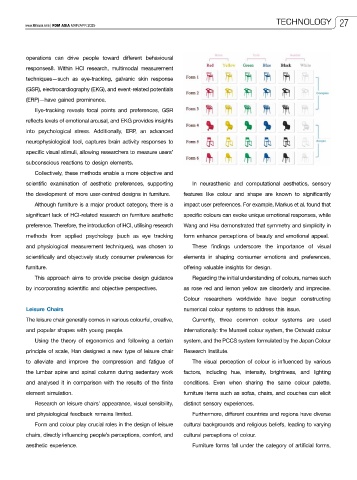
          The leisure chair generally comes in various colourful, creative,   Currently, three common colour systems are used
          and popular shapes with young people.              internationally: the Munsell colour system, the Ostwald colour
            Using the theory of ergonomics and following a certain   system, and the PCCS system formulated by the Japan Colour
          principle of scale, Han designed a new type of leisure chair   Research Institute.

          to alleviate and improve the compression and fatigue of   The visual perception of colour is influenced by various
          the lumbar spine and spinal column during sedentary work   factors, including  hue,  intensity,  brightness, and lighting
          and analysed it in comparison with the results of the finite   conditions.  Even  when  sharing the  same  colour  palette,
          element simulation.                                furniture items such as sofas, chairs, and couches can elicit
            Research on leisure chairs’ appearance, visual sensibility,   distinct sensory experiences.
          and physiological feedback remains limited.           Furthermore, different countries and regions have diverse
            Form and colour play crucial roles in the design of leisure   cultural backgrounds and religious beliefs, leading to varying

          chairs, directly influencing people’s perceptions, comfort, and   cultural perceptions of colour.
          aesthetic experience.                                 Furniture forms fall under the category of artificial forms,

