


Page 42 - FDMAsia MarApr 2025
P. 42
40   TECHNOLOGY                                                                   MAR/APR 2025 FDM ASIA | www.fdmasia.com


                                                             the panel industry. This context is in line with the concept of
                                                             industrial symbiosis, in which WW from the furniture industry
                                                             is incorporated to produce new wooden panels.
                                                                Therefore, it is appropriate to develop a network platform

                                                             to monitor the amount of available WW. This platform will allow
                                                             the panel industry to schedule its production with existing WW.
                                                                Threats are external variables that can create difficulties in
                                                             implementing the proposed products by the panel company. To
                                                             foster industrial symbiosis, it is necessary to create legislation
                                                             that encourages connections between industries.
                                                                In  regards  to  the  Circular  Economy,  there  is  a  need  for
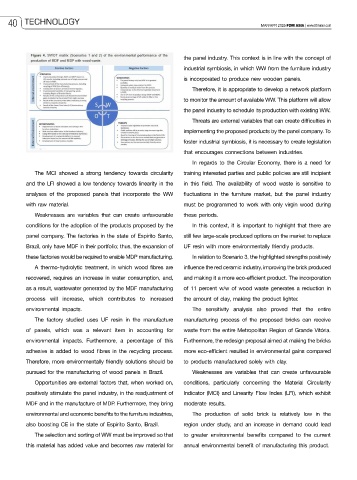
            The  MCI showed  a  strong tendency towards circularity   training interested parties and public policies are still incipient
          and the LFI showed a low tendency towards linearity in the   in this field. The availability of wood waste is sensitive to

          analyses of the proposed panels that incorporate the WW   fluctuations in the furniture market, but the panel industry
          with raw material.                                 must be programmed to work with only virgin wood during
            Weaknesses  are  variables  that  can  create  unfavourable   these periods.
          conditions for the adoption of the products proposed by the   In this context, it is important to highlight that there are
          panel company. The factories in the state of Espírito Santo,   still few large-scale produced options on the market to replace
          Brazil, only have MDF in their portfolio; thus, the expansion of   UF resin with more environmentally friendly products.
          these factories would be required to enable MDP manufacturing.   In relation to Scenario 3, the highlighted strengths positively

            A thermo-hydrolytic treatment, in which wood fibres are   influence the red ceramic industry, improving the brick produced
          recovered, requires an increase in water consumption, and,   and making it a more eco-efficient product. The incorporation
          as a result, wastewater generated by the MDF manufacturing   of 11 percent w/w of wood waste generates a reduction in
          process will increase, which contributes to increased   the amount of clay, making the product lighter.
          environmental impacts.                                The sensitivity analysis also proved that the entire
            The factory studied uses UF resin in the manufacture   manufacturing process of the proposed bricks can receive
          of  panels,  which  was  a  relevant item  in  accounting  for   waste from the entire Metropolitan Region of Grande Vitória.
          environmental impacts. Furthermore, a percentage of this   Furthermore, the redesign proposal aimed at making the bricks
          adhesive is added to wood fibres in the recycling process.   more eco-efficient resulted in environmental gains compared

          Therefore, more environmentally friendly solutions should be   to products manufactured solely with clay.
          pursued for the manufacturing of wood panels in Brazil.  Weaknesses  are  variables  that  can  create  unfavourable
            Opportunities are external factors that, when worked on,   conditions, particularly concerning the Material Circularity
          positively stimulate the panel industry, in the readjustment of   Indicator (MCI) and Linearity Flow Index (LFI), which exhibit
          MDF and in the manufacture of MDP. Furthermore, they bring   moderate results.
          environmental and economic benefits to the furniture industries,   The production of solid brick is relatively low in the
          also boosting CE in the state of Espírito Santo, Brazil.   region under study, and an increase in demand could lead

            The selection and sorting of WW must be improved so that   to greater environmental benefits compared to the current
          this material has added value and becomes raw material for   annual environmental benefit of manufacturing this product.

