


Page 47 - FDMAsia SepOct 2025
P. 47
TECHNOLOGY           45
         www.fdmasia.com | FDM ASIA SEP/OCT 2025


          Table 8. Effect of Lumber Price Changes on Annual Profit   Table 9. Best/Worse-case Scenario – Total Effect on Annual
          and Value for 12, 8, and 4 MMBF Capacity Sawmills  Sawmill Profitability if Log and Operating Cost Change
                                                             Opposite of Lumber Prices


          Combined Leverage                                     While interesting to consider, a situation as described
          The increases/decreases in annual profits described in Tables   in Table 9 is unlikely to happen (with the same percentage
          6, 7, and 8 show the volatility of the sawmill business. This   changes to operating cost, log cost, and lumber prices

          volatility is amplified when changes in operating costs, log   occurring simultaneously).
          costs, and lumber prices are combined.                In addition, while a 25 percent cost/price change is quite
            In  a worst-case  scenario, operating cost  and log  costs   a large swing in costs/price, even small changes, such as
          increase while lumber prices decrease, a situation not far from   +/- 0.25 percent, can change the profit/loss of a sawmill
          what has happened over much of 2024.               considerably as can be seen in Table 10.
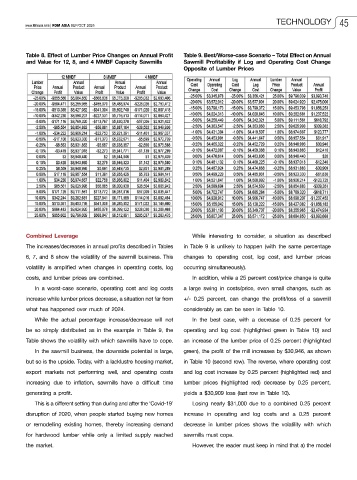
            While the actual percentage increase/decrease will not   In the best case, with a decrease of 0.25 percent for
          be so simply distributed as in the example in Table 9, the   operating and log cost (highlighted green in Table 10) and
          Table shows the volatility with which sawmills have to cope.   an increase of the lumber price of 0.25 percent (highlighted
            In the sawmill business, the downside potential is large,   green), the profit of the mill increases by $30,946, as shown

          but so is the upside. Today, with a lacklustre housing market,   in Table 10 (second row). The reverse, where operating cost
          export markets not  performing well, and operating costs   and log cost increase by 0.25 percent (highlighted red) and
          increasing due  to inflation, sawmills have a difficult time   lumber prices (highlighted red) decrease by 0.25 percent,
          generating a profit.                               yields a $30,909 loss (last row in Table 10).
            This is a different setting than during and after the ‘Covid-19’   Losing nearly $31,000 due to a combined 0.25 percent
          disruption of 2020, when people started buying new homes   increase in operating and log costs and a 0.25 percent
          or remodelling existing homes, thereby increasing demand   decrease in lumber prices shows the volatility with which

          for hardwood lumber while only a limited supply reached   sawmills must cope.
          the market.                                           However, the reader must keep in mind that a) the model

