


Page 50 - FDMAsia SepOct 2025
P. 50
48   DESIGN                                                                       SEP/OCT 2025 FDM ASIA | www.fdmasia.com


         Flickr                                              with a growing emphasis on adaptability, modularity, and comfort.
                                                                Moreover, contemporary furniture design reflects a global
                                                             exchange of ideas, blending cultural influences with cutting-
                                                             edge materials and production techniques.

                                                                It plays a vital role in architecture, interior design, and even
                                                             social commentary—challenging norms, promoting inclusivity,
                                                             and addressing societal issues such as climate change and
                                                             overconsumption.
                                                                This paper explores the evolution of furniture design from
                                                             historical  traditions to its  current  status in modern life. The
          Roman furniture
                                                             aim of this article is a historical analysis. It will examine how
            Furniture design encompasses the creation and development   changing societal  needs  and  technological advancements
          of  furnishings  intended  to  support various human  activities   have shaped design practices,  and how, in turn, furniture

          such as seating, sleeping, and storage. More than mere utility   influences the way people interact with their environments.
          objects, furniture items are cultural artifacts that reflect the   Ultimately, understanding the evolution and impact of
          values, technological capacities, and aesthetic sensibilities   furniture design offers a deeper insight into the values and
          of their time.                                     aspirations of contemporary society, highlighting the profound
            In contemporary society, the increasing emphasis on   connection between design and daily human experience.
          sustainable living, spatial efficiency, and technological integration
          has propelled furniture design into a critical domain of innovation   Historical Overview of Furniture Design

          and social relevance.                              The evolution of furniture design mirrors the broader trajectory
            The Modernist movement of the 20th century further   of human civilisation. Ancient Egyptian furniture, for example,
          transformed furniture, emphasising minimalism, functionalism,   was  characterised  by  hierarchical  symbolism  and  ornate
          and simplicity. Bauhaus and Scandinavian designers championed   craftsmanship, while the Greco-Roman tradition emphasised
          democratic design—sing clean lines, efficient production   proportion and order.
          processes, and honest use of materials.               The Renaissance period witnessed a revival of classical
            Simultaneously, the concept of furniture-as-architecture   aesthetics, with increased attention to comfort and ornamentation.
          began to emerge, with designers integrating storage, structure,
          and form into cohesive living environments.        Egyptian furniture (c. 3000 BCE–late period)

            In the context of contemporary society, furniture design   This style was often portable, richly symbolic, and crafted with
          has undergone a significant transformation—moving beyond   lightweight  wood,  ivory,  and  bronze.  Royal  beds  and  stools
          its traditional utilitarian role to become a powerful medium for   incorporated bronze hinges and animal-leg motifs, reflecting
          expressing identity, values, and lifestyle preferences.   funerary beliefs and status.
            Designers today are increasingly driven by concerns such
          as sustainability, environmental impact, multifunctionality, and   Greek and Roman furniture
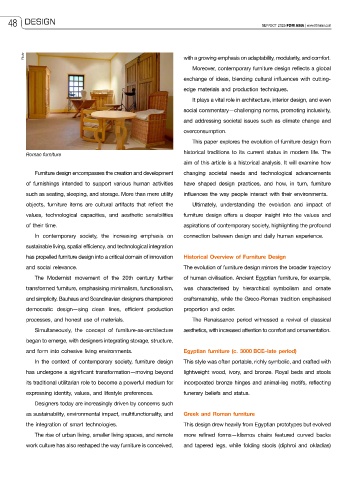
          the integration of smart technologies.             This design drew heavily from Egyptian prototypes but evolved

            The rise of urban living, smaller living spaces, and remote   more  refined  forms—klismos  chairs  featured  curved backs
          work culture has also reshaped the way furniture is conceived,   and tapered legs, while folding stools (diphroi and okladias)

