


Page 51 - FDMAsia SepOct 2025
P. 51
DESIGN       49
         www.fdmasia.com | FDM ASIA SEP/OCT 2025


          emphasised practicality and elegance.              Industrial revolution and Arts & Crafts
            A comparative study of Greek vs. Roman furniture design   Mechanised production in the 19th century democratised
          highlights differences shaped by politics, economy, and religion   furniture, but  also  sparked the Arts & Crafts  resistance—
          e.g., Peloponnesian silver-inlaid diphros vs. Roman carpentry.  advocating for handcrafted quality, honest materials, and

                                                             human-centred design.
          Ming Dynasty furniture
          In China, traditional furniture is renowned for its elegant   Modernism (20th century)
          simplicity, exquisite craftsmanship, and functional design,   Movements such as Bauhaus, De Stijl, and Scandinavian Modern
          often crafted from precious hardwoods such as rosewood   radically redefined form and function. Designers embraced
          and sandalwood.                                    tubular steel, moulded plywood, and minimal ornamentation.
            This period (roughly 1368 to 1644 AD) is considered a   These shifts prioritised utility and mass production, reshaping
          golden age for Chinese furniture, characterised by clean   ideals of domestic living.
          lines, harmonious proportions, and the use of intricate joinery   Walter Gropius, Ludwig Mies van der Rohe, Marcel Breuer

          techniques that minimised the need for nails or screws.  are key figures for Bauhaus, Theo van Doesburg, Piet Mondrian
                                                             are key figures for De Stijl, and Arne Jacobsen, Hans Wegner,
          Medieval to Renaissance                            Alvar Aalto are key figures for Scandinavian Modern designers.
          Following the collapse of the Roman world, the Middle Ages
          emphasised durability over decoration until the Gothic and   Contemporary and Cultural Perspectives
          Renaissance periods revived woodworking artistry—with   •  Modern design explores cultural identity and emotional
          carved panels, ornate reliefs, and classical symmetry inspired   resonance. A thematic review underscores how furniture

          by antiquity.                                         integrates traditional values with ergonomic and emotional
            Andrea Palladio and designers such as Michelangelo   factors in different cultures.
          influenced furniture design during the Renaissance, moving   •  The development of zero-waste design—using algorithmic
          away from the Gothic style of the Middle Ages.        layout optimisation—reflects sustainability goals and
                                                                innovative material use.
          Baroque, Rococo and Neoclassicism                  •  Meanwhile, ancient traditions continue inspiring contemporary
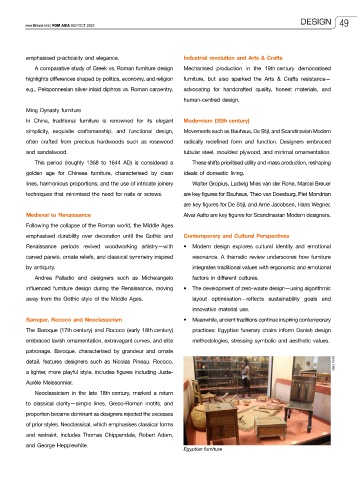
          The Baroque (17th century) and Rococo (early 18th century)   practices: Egyptian funerary chairs inform Danish design
          embraced lavish ornamentation, extravagant curves, and elite   methodologies, stressing symbolic and aesthetic values.
          patronage. Baroque, characterised by grandeur and ornate

          detail, features designers such as Nicolas Pineau. Rococo,                                          Gary Todd
          a lighter, more playful style, includes figures including Juste-
          Aurèle Meissonnier.
            Neoclassicism  in  the  late  18th century,  marked  a  return
          to classical clarity—simple lines, Greco-Roman motifs, and
          proportion became dominant as designers rejected the excesses
          of prior styles. Neoclassical, which emphasises classical forms

          and restraint, includes Thomas Chippendale, Robert Adam,
          and George Hepplewhite.
                                                             Egyptian furniture

