


Page 39 - FDMAsia SepOct 2025
P. 39
TECHNOLOGY           37
         www.fdmasia.com | FDM ASIA SEP/OCT 2025


          has been illustrated respectively. A thorough examination of   mean free path and an increase in hardness, leading to an
          the SEM micrographs indicated that the deterioration of the   increase in wear resistance.
          cutting edge predominantly occurred on the working surface,   However, the utilisation of 0.7 µm grains diminished the
          a consequence of the friction between the working surface   resistance of this material to strong impacts and heavy cutting.

          and the workpiece.                                 The absence of impact resistance renders such materials
            SEM images obtained at higher magnifications reveal the   unsuitable for utilisation under particularly exacting cutting
          presence  of  tungsten  carbide grains  that protrude  convexly   conditions.
          from the wear surface.                                Consequently, the authors proposed the utilisation of an
            In addition, the images show depressions that were once   enhanced cutting insert design, entailing modifications to the
          occupied by carbide grains but had since been removed.   geometry and the refinement of the quality of the cutting edge
            It is hypothesised that, for blades with grain sizes of 0.4   through the employment of modified grinding techniques.
          and 0.8 µm, wear occurs through the removal of the cobalt   Blades with nanometre-sized WC grains can fracture or
          bond between the WC grains, which then leads to the removal   break off fragments due to mechanical action, resulting in a

          of the WC grains themselves.                       deterioration in machining quality. Mechanical stresses are
            The observation that the wear surfaces of submicron WC   caused by forces during the cutting process, such as pressure,
          grain sizes are similar in appearance suggests that analogous   impact, or vibration.
          wear mechanisms.                                      These forces can weaken the blade’s structure, particularly
            Numerous scientific studies confirm that the preferential   in weak or damaged areas. To minimise this risk, it is necessary
          removal of tungsten carbide grains during the wear process   to regularly monitor blade condition, use appropriate machining
          is a complex, multifaceted phenomenon occurring through   parameters, and use durable, stress-resistant materials.

          various physicochemical mechanisms.                   The EDS analysis of all the tested blade variants revealed
            The most important of these are chemical corrosion,   the presence of elements such as calcium, silicon, and oxygen,
          oxidation, extrusion, and abrasion. In practice, it is highly   in addition to tungsten, carbon, and cobalt.
          likely that multiple mechanisms are at work simultaneously   These elements are not part of the tool material itself,
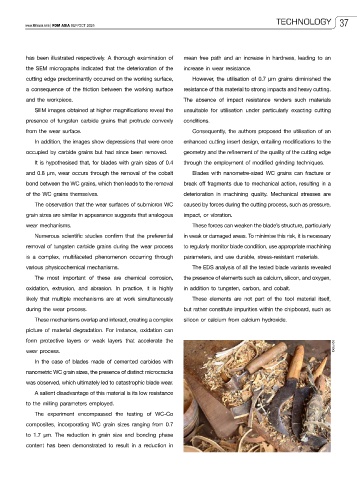
          during the wear process.                           but rather constitute impurities within the chipboard, such as
            These mechanisms overlap and interact, creating a complex   silicon or calcium from calcium hydroxide.
          picture  of  material  degradation.  For  instance,  oxidation  can
          form  protective  layers  or  weak  layers  that  accelerate  the
          wear process.                                                                                       Dotun55

            In the case of blades made of cemented carbides with
          nanometric WC grain sizes, the presence of distinct microcracks
          was observed, which ultimately led to catastrophic blade wear.
            A salient disadvantage of this material is its low resistance
          to the milling parameters employed.
            The  experiment  encompassed  the testing of  WC-Co
          composites, incorporating WC grain sizes ranging from 0.7

          to 1.7 µm. The reduction in grain size and bonding phase
          content has been demonstrated to result in a reduction in

