


Page 36 - FDMAsia SepOct 2025
P. 36
34   TECHNOLOGY                                                                   SEP/OCT 2025 FDM ASIA | www.fdmasia.com


         Needpix.com                                         is attributable to the direct heating of the compressed powder
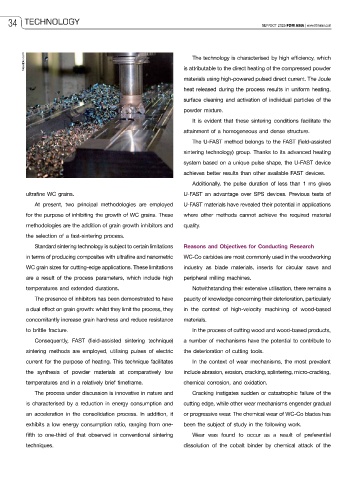
                                                                The technology is characterised by high efficiency, which

                                                             materials using high-powered pulsed direct current. The Joule
                                                             heat released during the process results in uniform heating,

                                                             surface cleaning and activation of individual particles of the
                                                             powder mixture.
                                                                It is evident that these sintering conditions facilitate the
                                                             attainment of a homogeneous and dense structure.
                                                                The U-FAST method belongs to the FAST (field-assisted
                                                             sintering technology) group. Thanks to its advanced heating
                                                             system based on a unique pulse shape, the U-FAST device
                                                             achieves better results than other available FAST devices.
                                                                Additionally,  the  pulse  duration of less than  1 ms  gives

          ultrafine WC grains.                               U-FAST an advantage over SPS devices. Previous tests of
            At present, two principal methodologies are employed   U-FAST materials have revealed their potential in applications
          for the purpose of inhibiting the growth of WC grains. These   where other methods cannot achieve the required material
          methodologies are the addition of grain growth inhibitors and   quality.
          the selection of a fast-sintering process.
            Standard sintering technology is subject to certain limitations   Reasons and Objectives for Conducting Research
          in terms of producing composites with ultrafine and nanometric   WC-Co carbides are most commonly used in the woodworking

          WC grain sizes for cutting-edge applications. These limitations   industry as blade materials, inserts for circular saws and
          are a result of the process parameters, which include high   peripheral milling machines.
          temperatures and extended durations.                  Notwithstanding their extensive utilisation, there remains a
            The presence of inhibitors has been demonstrated to have   paucity of knowledge concerning their deterioration, particularly
          a dual effect on grain growth: whilst they limit the process, they   in the context of high-velocity machining of wood-based
          concomitantly increase grain hardness and reduce resistance   materials.
          to brittle fracture.                                  In the process of cutting wood and wood-based products,
            Consequently, FAST (field-assisted sintering technique)   a number of mechanisms have the potential to contribute to
          sintering methods are employed, utilising pulses of electric   the deterioration of cutting tools.

          current for the purpose of heating. This technique facilitates   In the context of wear mechanisms, the most prevalent
          the synthesis of powder materials at comparatively low   include abrasion, erosion, cracking, splintering, micro-cracking,
          temperatures and in a relatively brief timeframe.   chemical corrosion, and oxidation.
            The process under discussion is innovative in nature and   Cracking instigates sudden or catastrophic failure of the
          is characterised by a reduction in energy consumption and   cutting edge, while other wear mechanisms engender gradual
          an acceleration in the consolidation process. In addition, it   or progressive wear. The chemical wear of WC-Co blades has
          exhibits a low energy consumption ratio, ranging from one-  been the subject of study in the following work.

          fifth to one-third of that observed in conventional sintering   Wear was found to occur as a result of preferential
          techniques.                                        dissolution of the cobalt binder by chemical attack of the

