


Page 35 - FDMAsia SepOct 2025
P. 35
TECHNOLOGY           33
         www.fdmasia.com | FDM ASIA SEP/OCT 2025


          boasts a number of advantages, including dimensional stability,                                     PxHere
          good strength characteristics, and resistance to temperature
          and moisture fluctuations.
            It is unfortunate that, in addition to wood in particle or

          fibre form, binders, fillers and thinners, particleboard and
          fibreboard also contain silica.
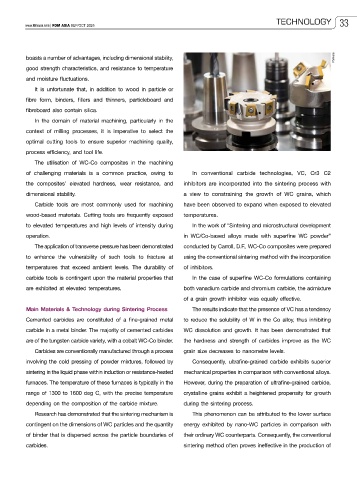
            In the domain of material machining, particularly in the
          context of milling processes, it is imperative to select the
          optimal cutting tools to ensure superior machining quality,
          process efficiency, and tool life.
            The utilisation of WC-Co composites in the machining
          of challenging materials is a common practice, owing to   In conventional carbide technologies, VC, Cr3 C2
          the composites’ elevated hardness, wear resistance, and   inhibitors are incorporated into the sintering process with

          dimensional stability.                             a view to constraining the growth of WC grains, which
            Carbide tools are  most commonly  used  for machining   have been observed to expand when exposed to elevated
          wood-based materials. Cutting tools are frequently exposed   temperatures.
          to elevated temperatures and high levels of intensity during   In the work of “Sintering and microstructural development
          operation.                                         in WC/Co-based alloys made with superfine WC powder”
            The application of transverse pressure has been demonstrated   conducted by Carroll, D.F., WC-Co composites were prepared
          to enhance the vulnerability of such tools to fracture at   using the conventional sintering method with the incorporation

          temperatures that exceed ambient levels. The durability of   of inhibitors.
          carbide tools is contingent upon the material properties that   In the case of superfine WC-Co formulations containing
          are exhibited at elevated temperatures.            both vanadium carbide and chromium carbide, the admixture
                                                             of a grain growth inhibitor was equally effective.
          Main Materials & Technology during Sintering Process  The results indicate that the presence of VC has a tendency
          Cemented carbides are constituted of a fine-grained metal   to reduce the solubility of W in the Co alloy, thus inhibiting
          carbide in a metal binder. The majority of cemented carbides   WC dissolution and growth. It has been demonstrated that
          are of the tungsten carbide variety, with a cobalt WC-Co binder.   the  hardness  and  strength  of  carbides  improve  as  the  WC
            Carbides are conventionally manufactured through a process   grain size decreases to nanometre levels.

          involving the cold pressing of powder mixtures, followed by   Consequently, ultrafine-grained carbide exhibits superior
          sintering in the liquid phase within induction or resistance-heated   mechanical properties in comparison with conventional alloys.
          furnaces. The temperature of these furnaces is typically in the   However, during the preparation of ultrafine-grained carbide,
          range of 1300 to 1600 deg C, with the precise temperature   crystalline grains exhibit a heightened propensity for growth
          depending on the composition of the carbide mixture.   during the sintering process.
            Research has demonstrated that the sintering mechanism is   This phenomenon can be attributed to the lower surface
          contingent on the dimensions of WC particles and the quantity   energy exhibited by nano-WC particles in comparison with

          of binder that is dispersed across the particle boundaries of   their ordinary WC counterparts. Consequently, the conventional
          carbides.                                          sintering method often proves ineffective in the production of

