


Page 43 - FDMAsia SepOct 2024
P. 43
TECHNOLOGY           41
         www.fdmasia.com | FDM ASIA SEP/OCT 2024


          can impact the viscosity of the coating, which therefore affects   density of the particle board may need to be individually
          the dry film thickness on wood surfaces.           tailored, as it largely determines its strength regarding various
            In addition, the durability of the tested coating was   mechanical properties, including MOR.
          discovered to be better for spruce wood, demonstrating   The MOE is also shown in the research. The trend is similar

          that  different  wood  species  can  influence  the  total  life  and   to that observed for the MOR: as the recycled wood content
          performance of the paint covering.                 increases, the MOE also increases. However, unlike the MOR
                                                             results, all variants met the standard for MOE.
          Modulus Of Rupture & Modulus Of Elasticity            For particleboard made from window frame particles
          The results for MOR are presented. The MOR value was   painted white, the highest MOE value was recorded for the
          observed to increase with the amount of recycled content.   variant made entirely from the alternative raw material at
            When analysing the MOR results for the variant using   3032 N mm−2, which is lower than the reference value of
          window frames with white paint, the highest MOR value was   3212 N mm−2.
          recorded for the variant made entirely from recycled particles   The lowest MOE value was observed in the panel where

          at 14.5 N mm−2, which is slightly lower than the reference   alternative particles accounted for 10 percent, with an MOE
          variant at 15.3 N mm−2.                            of 2251 N mm−2.
            The weakest performance was observed in the variant   In the case of specimens made from window frames with
          where recycled particles accounted for five parts by mass,   clear lacquer, the highest MOE value was also recorded for
          with an MOR value of 10.1 N mm−2.                  the variant made entirely from alternative particles, reaching
            For the clear varnish wood, the highest MOR value was   3665 N mm−2, which exceeds the reference value.
          achieved by the variant made entirely from recycled particles at   Conversely, the lowest MOE was obtained in the variant

          16.8 N mm−2, exceeding the reference value of 15.3 N mm−2.   where the recycled raw material constituted 10 parts by mass,
            The weakest performance in this category was seen in   recording a value of 2241 N mm−2. Research confirms that
          the variant containing 10 parts by mass of reclaimed wood,   recycled wood can reduce parameters such as the MOE.
          with an MOR value of 10.6 N mm−2. The lacquer increases   Nevertheless, the results met the EN 312 standards.
          the surface hardness of the particles, which can lead to an   During the preparation of the particleboard, dust fractions
          enhancement in the mechanical strength of the particleboards.   can also form, for example, when mixing the raw material
            Higher hardness can improve the MOR, as the lacquer   with the adhesive. Studies confirm that the presence of dust
          coating may serve as an additional protective layer, enhancing   fractions in the core layer of the board can contribute to the
          resistance to breaking.                            weakening of MOE parameters.

            A similar study investigated the effect of density and
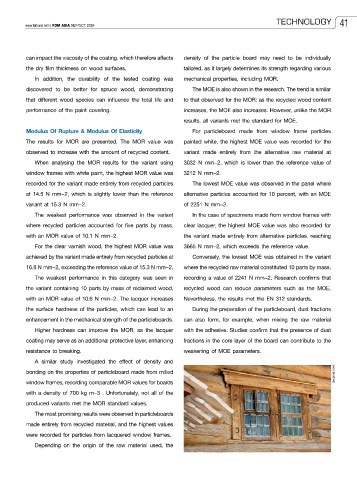
          bonding on the properties of particleboard made from milled                                         rawpixel.com
          window frames, recording comparable MOR values for boards
          with a density of 700 kg m−3 . Unfortunately, not all of the
          produced variants met the MOR standard values.
            The most promising results were observed in particleboards
          made entirely from recycled material, and the highest values

          were recorded for particles from lacquered window frames.
            Depending on the origin of the raw material used, the

