


Page 39 - FDMAsia SepOct 2024
P. 39
TECHNOLOGY           37
         www.fdmasia.com | FDM ASIA SEP/OCT 2024


          affect properties such as thickness swelling.         However, this process tends to degrade the raw material,
            The thermal performance of a window is greatly affected by   which negatively impacts its strength properties.
          the material used for its frame. With the growing emphasis on   It is important to note that, depending on atmospheric
          sustainable design, window frame materials must demonstrate   conditions, and the colour and quality of the coating, any

          superior environmental performance to be considered truly   varnish that is not removed during recycling can negatively
          sustainable.                                       impact the strength properties of the manufactured wood
            Consequently, a comprehensive performance metric is   materials.
          needed  to evaluate window  frame materials effectively.  This   However, it has also been demonstrated that a suitable
          study analysed three identical aluminium, polyvinyl chloride   coating can help maintain the highest wood quality.
          (PVC) frames and wood.                                Reclaimed wood from demolition can be successfully
            Their  thermal performance was initially assessed and   repurposed for structural use, with promising applications in
          compared using a heat transfer model. Subsequently, the carbon   creating engineered wood products (EWPs) like cross-laminated
          footprint of each material was calculated for a one-square-  timber (CLT) and glulam.

          meter window area with comparable thermal performance.   This approach minimises waste and contributes to the
            The  results  revealed  that  wood  window  frames  excelled   sustainability of wood construction by incorporating recycled
          over aluminium and PVC in thermal and environmental   materials into advanced building components. Recent projects
          performance. However, aluminium frames had a significant   have faced challenges, with unsatisfactory outcomes primarily
          environmental impact and lower thermal performance. This   due to wood species’ diversity and difficulties in sorting materials.
          study thoroughly analyses window frames, considering their   Wood sourced from furniture, window frames, and
          environmental and thermal performance.             mouldings presented significant obstacles to maximising the

            Window frames are classified as bulky waste, complicating   use of recycled materials.
          their collection and recycling compared to routine waste   As  a  result, subsequent efforts  have concentrated on
          materials. The collection process for window frames is less   developing more effective methods for sorting raw materials
          efficient than everyday waste. These frames serve as structural   for recycling.
          support, providing form and stability to each window.   A notable advantage of window frames is their relatively
            As lifestyle changes and economic conditions drive the   large dimensions, which makes them ideal for shredding and
          demand for inexpensive, quickly replaceable products, bulky   repurposing in applications such as particleboard production.
          waste, including window frames, has become a relatively   Recycling  wooden  window  frames  supports  a  closed-
          small but steadily increasing waste stream in many countries.

            Recycled wood can be used as a raw material in producing                                          John Loo
          wood-based composites, such as particleboard, fibreboard,
          and structural panels, resulting in high-value products.
            Unfortunately, the literature offers limited examples of
          recycling window frames, but there are instances of recycling
          other  wood–plastic  composites  that  could  inspire  further
          research. One notable example is the hydrothermal processing

          of particleboard, where the recovered wood material is reused
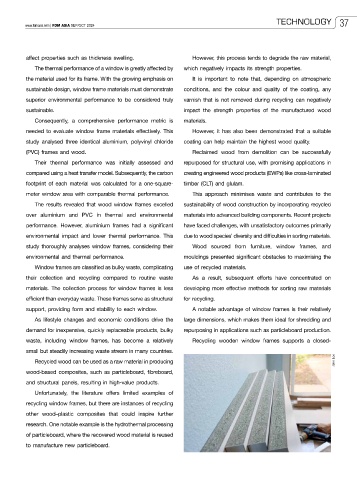
          to manufacture new particleboard.

