


Page 36 - FDMAsia SepOct 2024
P. 36
34    FOCUS                                                                       SEP/OCT 2024 FDM ASIA | www.fdmasia.com


         Freepik                                             obvious compliance wrinkles, but to give some thought to how
                                                             climate, trade and development policies might be combined
                                                             into a more coherent strategy,” it says.


                                                             EU implements eco-design regulation
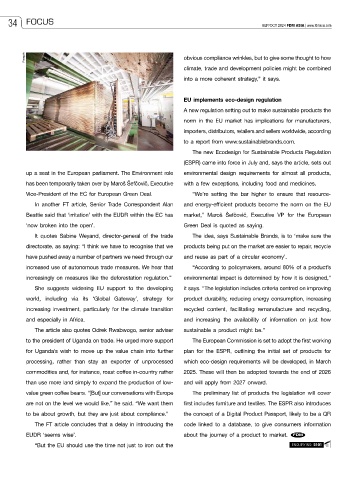
                                                             A new regulation setting out to make sustainable products the
                                                             norm in the EU market  has implications for manufacturers,
                                                             importers, distributors, retailers and sellers worldwide, according
                                                             to a report from www.sustainablebrands.com.
                                                                The new Ecodesign for Sustainable Products Regulation
                                                             (ESPR) came into force in July and, says the article, sets out
          up a seat in the European parliament. The Environment role   environmental design requirements for almost all products,
          has been temporarily taken over by Maroš Šefčovič, Executive   with a few exceptions, including food and medicines.

          Vice-President of the EC for European Green Deal.     “We’re setting the bar higher to ensure that resource-
            In  another  FT  article,  Senior  Trade  Correspondent  Alan   and energy-efficient products become the norm on the EU
          Beattie said that ‘irritation’ with the EUDR within the EC has   market,” Maroš Šefčovič, Executive VP for the European
          ‘now broken into the open’.                        Green Deal is quoted as saying.
            It quotes Sabine Weyand, director-general of the trade   The idea, says Sustainable Brands, is to ‘make sure the
          directorate, as saying: “I think we have to recognise that we   products being put on the market are easier to repair, recycle
          have pushed away a number of partners we need through our   and reuse as part of a circular economy’.

          increased use of autonomous trade measures. We hear that   “According to policymakers, around 80% of a product’s
          increasingly on measures like the deforestation regulation.”   environmental impact is determined by how it is designed,”
            She suggests widening EU support to the developing   it says. “The legislation includes criteria centred on improving
          world, including via its ‘Global Gateway’, strategy for   product durability, reducing energy consumption, increasing
          increasing investment, particularly for the climate transition   recycled content, facilitating remanufacture and recycling,
          and especially in Africa.                          and increasing the availability of information on just how
            The article also quotes Odrek Rwabwogo, senior adviser   sustainable a product might be.”
          to the president of Uganda on trade. He urged more support   The European Commission is set to adopt the first working
          for Uganda’s wish to move up the value chain into further   plan for the ESPR, outlining the initial set of products for

          processing, rather than stay an exporter of unprocessed   which eco-design requirements will be developed, in March
          commodities and, for instance, roast coffee in-country rather   2025. These will then be adopted towards the end of 2026
          than use more land simply to expand the production of low-  and will apply from 2027 onward.
          value green coffee beans. “[But] our conversations with Europe   The preliminary list of products the legislation will cover
          are not on the level we would like,” he said. “We want them   first includes furniture and textiles. The ESPR also introduces
          to be about growth, but they are just about compliance.”   the concept of a Digital Product Passport, likely to be a QR
            The FT article concludes that a delay in introducing the   code linked to a database, to give consumers information

          EUDR ‘seems wise’.                                 about the journey of a product to market.  FDM
            “But the EU should use the time not just to iron out the                            ENQUIRY NO. 5101

