


Page 38 - FDMAsia SepOct 2024
P. 38
36   TECHNOLOGY                                                                   SEP/OCT 2024 FDM ASIA | www.fdmasia.com


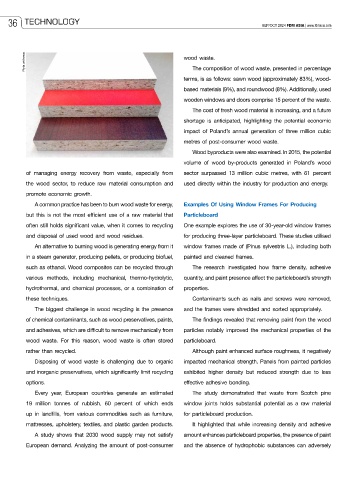
         Płyta wiórowa                                       wood waste.
                                                                The composition of wood waste, presented in percentage
                                                             terms, is as follows: sawn wood (approximately 83%), wood-
                                                             based materials (9%), and roundwood (8%). Additionally, used

                                                             wooden windows and doors comprise 15 percent of the waste.
                                                                The cost of fresh wood material is increasing, and a future
                                                             shortage is anticipated, highlighting the potential economic
                                                             impact  of  Poland’s  annual  generation  of  three  million  cubic
                                                             metres of post-consumer wood waste.
                                                                Wood byproducts were also examined. In 2015, the potential
                                                             volume of wood by-products generated in Poland’s wood
          of  managing  energy  recovery  from  waste,  especially  from   sector  surpassed  13  million  cubic  metres,  with  61  percent
          the wood sector, to reduce raw material consumption and   used directly within the industry for production and energy.

          promote economic growth.
            A common practice has been to burn wood waste for energy,   Examples Of Using Window Frames For Producing
          but this is not the most efficient use of a raw material that   Particleboard
          often still holds significant value, when it comes to recycling   One example explores the use of 30-year-old window frames
          and disposal of used wood and wood residues.       for producing three-layer particleboard. These studies utilised
            An alternative to burning wood is generating energy from it   window frames made of (Pinus sylvestris L.), including both
          in a steam generator, producing pellets, or producing biofuel,   painted and cleaned frames.

          such as ethanol. Wood composites can be recycled through   The research investigated how frame density, adhesive
          various methods, including mechanical, thermo-hydrolytic,   quantity, and paint presence affect the particleboard’s strength
          hydrothermal, and chemical processes, or a combination of   properties.
          these techniques.                                     Contaminants such as nails and screws were removed,
            The biggest challenge in wood recycling is the presence   and the frames were shredded and sorted appropriately.
          of chemical contaminants, such as wood preservatives, paints,   The findings revealed that removing paint from the wood
          and adhesives, which are difficult to remove mechanically from   particles notably improved  the mechanical properties of the
          wood waste. For this reason, wood waste is often stored   particleboard.
          rather than recycled.                                 Although paint enhanced surface roughness, it negatively

            Disposing  of  wood  waste  is  challenging  due  to  organic   impacted mechanical strength. Panels from painted particles
          and inorganic preservatives, which significantly limit recycling   exhibited higher density but reduced strength due to less
          options.                                           effective adhesive bonding.
            Every year, European countries generate an estimated   The study demonstrated that waste from Scotch pine
          19 million tonnes of rubbish, 60 percent of which ends   window joints holds substantial potential as a raw material
          up  in landfills, from various commodities  such  as furniture,   for particleboard production.
          mattresses, upholstery, textiles, and plastic garden products.   It  highlighted  that  while  increasing  density  and  adhesive

            A study shows that 2030 wood supply may not satisfy   amount enhances particleboard properties, the presence of paint
          European demand. Analyzing the amount of post-consumer   and the absence of hydrophobic substances can adversely

