


Page 48 - FDMAsia SepOct 2024
P. 48
46   TECHNOLOGY                                                                   SEP/OCT 2024 FDM ASIA | www.fdmasia.com


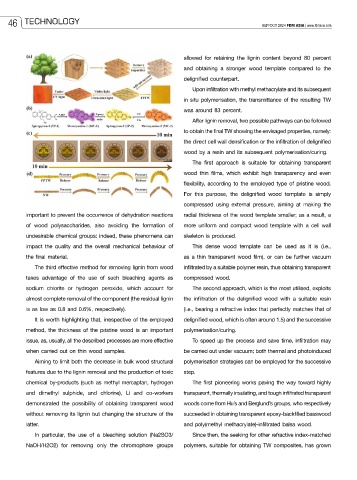
                                                             allowed for retaining the lignin content beyond 80 percent
                                                             and obtaining a stronger wood template compared to the
                                                             delignified counterpart.
                                                                Upon infiltration with methyl methacrylate and its subsequent

                                                             in situ polymerisation, the transmittance of the resulting TW
                                                             was around 83 percent.
                                                                After lignin removal, two possible pathways can be followed
                                                             to obtain the final TW showing the envisaged properties, namely:
                                                             the direct cell wall densification or the infiltration of delignified
                                                             wood by a resin and its subsequent polymerisation/curing.
                                                                The first approach is suitable for obtaining transparent
                                                             wood thin films, which exhibit high transparency and even
                                                             flexibility, according to the employed type of pristine wood.

                                                             For this purpose, the delignified wood template is simply
                                                             compressed  using  external  pressure,  aiming  at  making  the
          important to prevent the occurrence of dehydration reactions   radial thickness of the wood template smaller; as a result, a
          of  wood  polysaccharides,  also  avoiding  the  formation  of   more uniform and compact  wood  template with  a  cell wall
          undesirable chemical groups: indeed, these phenomena can   skeleton is produced.
          impact the quality and the overall mechanical behaviour of   This dense wood template can be used as it is (i.e.,
          the final material.                                as a thin transparent wood film), or can be further vacuum

            The third effective method for removing lignin from wood   infiltrated by a suitable polymer resin, thus obtaining transparent
          takes advantage of the use of such bleaching agents as   compressed wood.
          sodium chlorite or hydrogen peroxide, which account for   The second approach, which is the most utilised, exploits
          almost complete removal of the component (the residual lignin   the infiltration of the delignified wood with a suitable resin
          is as low as 0.8 and 0.6%, respectively).          (i.e., bearing a refractive index that perfectly matches that of
            It is worth highlighting that, irrespective of the employed   delignified wood, which is often around 1.5) and the successive
          method, the thickness of the pristine wood is an important   polymerisation/curing.
          issue, as, usually, all the described processes are more effective   To speed up the process and save time, infiltration may
          when carried out on thin wood samples.             be carried out under vacuum; both thermal and photoinduced

            Aiming to limit both the decrease in bulk wood structural   polymerisation strategies can be employed for the successive
          features due to the lignin removal and the production of toxic   step.
          chemical by-products (such as methyl mercaptan, hydrogen   The first pioneering works paving the way toward highly
          and dimethyl sulphide, and chlorine), Li and co-workers   transparent, thermally insulating, and tough infiltrated transparent
          demonstrated the possibility of obtaining transparent wood   woods come from Hu’s and Berglund’s groups, who respectively
          without removing its lignin but changing the structure of the   succeeded in obtaining transparent epoxy-backfilled basswood
          latter.                                            and poly(methyl methacrylate)-infiltrated balsa wood.

            In particular, the use of a bleaching solution (Na2SO3/  Since then, the seeking for other refractive index-matched
          NaOH/H2O2) for removing only the chromophore groups   polymers, suitable for obtaining TW composites, has grown

