


Page 49 - FDMAsia SepOct 2024
P. 49
TECHNOLOGY           47
         www.fdmasia.com | FDM ASIA SEP/OCT 2024


          remarkably.                                           Du and co-workers developed an optically switchable
            However, both mechanical and optical features of the   and mechanically resistant perovskite-coated thermochromic
          resulting TW can be worsened due to shrinking phenomena,   transparent wood (derived from delignified balsa wood that
          which the infiltrated polymers may undergo during their   was subsequently infiltrated with poly(methyl methacrylate))

          polymerisation/curing: consequently, cracks or defects alongside   to be employed as an effective smart window.
          the interface between the bleached wood scaffold and the   This latter exhibited not only enhanced mechanical behaviour
          infiltrated resin may originate.                   (i.e., enhanced tensile and flexural strength – about 71 and
            Some strategies have been proposed to overcome these   93 MPa, respectively) but also a significant solar modulation
          issues. They include: i) the use of refractive index-matched   capability and an optical transmittance as high as 78 percent,
          resins  that  exhibit  a low  shrinkage  upon  curing,  and  ii)  the   suitable for the design of novel glazing materials having
          modification, usually by esterification, of the hydroxyl-rich inner   enhanced thermal regulation and energy-saving potential.
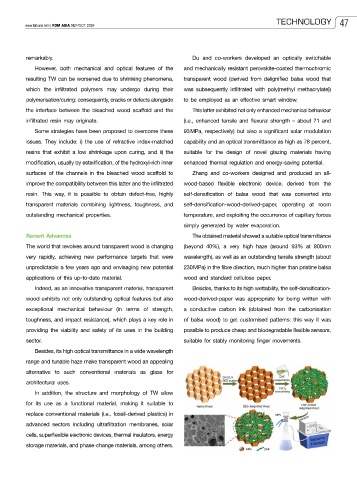
          surfaces of the channels in the bleached wood scaffold to   Zhang and co-workers designed and produced an all-
          improve the compatibility between this latter and the infiltrated   wood-based flexible electronic device, derived from the

          resin. This  way,  it is possible to obtain defect-free, highly   self-densification of balsa wood that was converted into
          transparent materials combining lightness, toughness, and   self-densification-wood-derived-paper, operating at room
          outstanding mechanical properties.                 temperature, and exploiting the occurrence of capillary forces
                                                             simply generated by water evaporation.
          Recent Advances                                       The obtained material showed a suitable optical transmittance
          The world that revolves around transparent wood is changing   (beyond 40%), a very high haze (around 93% at 800 nm
          very rapidly, achieving new  performance targets that were   wavelength), as well as an outstanding tensile strength (about

          unpredictable a few years ago and envisaging new potential   230 MPa) in the fibre direction, much higher than pristine balsa
          applications of this up-to-date material.          wood and standard cellulose paper.
            Indeed, as an innovative transparent material, transparent   Besides, thanks to its high wettability, the self-densification-
          wood exhibits not only outstanding optical features but also   wood-derived-paper was appropriate for being written with
          exceptional mechanical behaviour (in terms of strength,   a conductive carbon ink (obtained from the carbonisation
          toughness, and impact resistance), which plays a key role in   of balsa wood) to get customised patterns: this way it was
          providing the viability and safety of its uses in the building   possible to produce cheap and biodegradable flexible sensors,
          sector.                                            suitable for stably monitoring finger movements.
            Besides, its high optical transmittance in a wide wavelength

          range and tunable haze make transparent wood an appealing
          alternative  to  such  conventional  materials  as  glass  for
          architectural uses.
            In addition, the structure and morphology of TW allow
          for its use as a functional material, making it suitable to
          replace conventional materials (i.e., fossil-derived plastics) in
          advanced sectors including ultrafiltration membranes, solar

          cells, superflexible electronic devices, thermal insulators, energy
          storage materials, and phase-change materials, among others.

