


Page 51 - FDMAsia SepOct 2024
P. 51
TECHNOLOGY           49
         www.fdmasia.com | FDM ASIA SEP/OCT 2024


          energy storage properties.                            The so-obtained composite films (0.5 mm thickness) exhibited
            To this aim, balsa wood was delignified with sodium chlorite   high optical transmittance (about 91%), water absorption
          and subsequently impregnated under vacuum with a mixture   stability (weight gain rate below 9%), good longitudinal tensile
          of epoxy resin, poly(ethylene glycol), and triethyl phosphate.   strength (about 140 MPa), and UV-shielding properties.

            The obtained wood self-extinguished in flammability tests   Bisht and co-workers assessed the effect of environmental
          (thanks to the presence of triethyl phosphate), and exhibited   conditions (in particular, of natural weathering) on the properties
          the envisaged phase change energy storage features (provided   of TW composites (derived from delignified melia and poplar
          by the embedded poly(ethylene glycol)), keeping high optical   woods, further infiltrated with an epoxy resin), considering
          transparency (about 95%), high tensile strength (around 2 MPa),   possible changes in colour, optical transmittance, visual
          and impact resistance (around 8 kJ/m2).            appearance, and chemical structure.
            A similar approach was exploited by Li and co-workers, who   Solar radiation was responsible for photo-oxidative
          obtained phase change energy storage woods exhibiting high   degradation phenomena that occurred soon after the start
          photo-thermal conversion effectiveness through delignification   of the tests. Both colour darkening and optical transmittance

          of balsa wood and its subsequent impregnation with a   losses (by about 34%) occurred.
          poly(ethylene glycol)-based composite containing graphene   Conversely, these photo-oxidation phenomena were quite
          quantum dot-grafted boron nitride as a thermal conductive filler.   significantly reduced through the incorporation (at 1.75 wt%
            Even 6 wt% of graphene quantum dot-grafted boron   loading) of a benzotriazole-derived UV absorber in the
          nitride guaranteed high optical transparency and thermal   formulation of the infiltrated epoxy resin, limiting the optical
          conductivity  (around 0.392 W/(m-K); besides, for  the same   transmittance loss to about 15 percent.
          system, solidification and melting enthalpies achieved about   A flexible reversibly  photoresponsive  transparent  wood,

          114 and 115 J/g, hence indicating a high latent heat value.   suitable for the design of sensors and electronic devices, was
          Finally, the temperature of phase transformation was in the   recently proposed by Tian and co-workers.
          range between 20.3 and 36.3 deg C, i.e., compatible with   To this aim, a delignified balsa wood template was infiltrated
          that of the human body.                            with a flexible epoxy resin (namely, Hasuncast 3016LV from
            A nice example of the use of functional transparent   Huasheng Tongchuang Technology, China) and a spiropyran
          wood for smart window applications was proposed by Zhou   solution.
          and co-workers, who prepared epoxy-based balsa wood   As a photosensitive dye, spiropyran was able to break the
          TW composites containing carbon quantum dots (derived   carbon-oxygen bond upon UV irradiation, hence promoting a
          from chitosan or o-phenylenediamine) showing yellow or red   remarkable colour change.

          fluorescence, respectively.
            The so-obtained materials exhibited a good optical
          transmittance of around 70 percent, a high UV blocking rate
          (about 80% for the yellow and 89% for the red fluorescence
          TW), excellent water resistance,  high  durability, and thermal
          insulation.
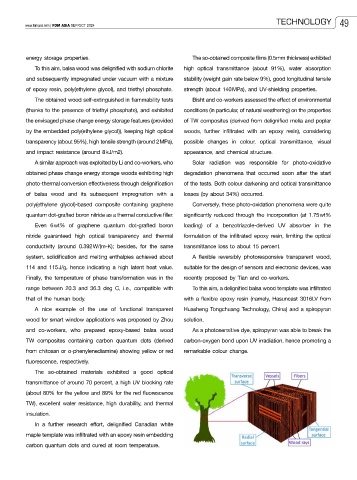
            In a further research effort, delignified Canadian white

          maple template was infiltrated with an epoxy resin embedding
          carbon quantum dots and cured at room temperature.

