


Page 55 - FDMAsia SepOct 2024
P. 55
MATERIALS         53
         www.fdmasia.com | FDM ASIA SEP/OCT 2024


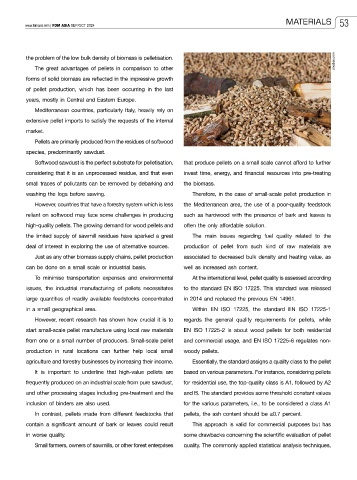
          the problem of the low bulk density of biomass is pelletisation.                                    pixabay.com
            The great advantages of pellets in comparison to other
          forms of solid biomass are reflected in the impressive growth
          of pellet production, which has been occurring in the last

          years, mostly in Central and Eastern Europe.
            Mediterranean countries, particularly Italy, heavily rely on
          extensive pellet imports to satisfy the requests of the internal
          market.
            Pellets are primarily produced from the residues of softwood
          species, predominantly sawdust.
            Softwood sawdust is the perfect substrate for pelletisation,   that produce pellets on a small scale cannot afford to further
          considering that it is an unprocessed residue, and that even   invest time, energy, and financial resources into pre-treating
          small traces of pollutants can be removed by debarking and   the biomass.

          washing the logs before sawing.                       Therefore, in the case of small-scale pellet production in
            However, countries that have a forestry system which is less   the Mediterranean area, the use of a poor-quality feedstock
          reliant on softwood may face some challenges in producing   such as hardwood with the presence of bark and leaves is
          high-quality pellets. The growing demand for wood pellets and   often the only affordable solution.
          the limited supply of sawmill residues have sparked a great   The main issues regarding fuel quality related to the
          deal of interest in exploring the use of alternative sources.  production of pellet from such kind of raw materials are
            Just as any other biomass supply chains, pellet production   associated to decreased bulk density and heating value, as

          can be done on a small scale or industrial basis.   well as increased ash content.
            To minimise transportation expenses and environmental   At the international level, pellet quality is assessed according
          issues, the industrial manufacturing of pellets necessitates   to the standard EN ISO 17225. This standard was released
          large quantities of readily available feedstocks concentrated   in 2014 and replaced the previous EN 14961.
          in a small geographical area.                         Within EN ISO 17225, the standard EN ISO 17225-1
            However, recent research has shown how crucial it is to   regards the general quality requirements for pellets, while
          start small-scale pellet manufacture using local raw materials   EN ISO 17225-2 is about wood pellets for both residential
          from one or a small number of producers. Small-scale pellet   and commercial usage, and EN ISO 17225-6 regulates non-
          production in rural locations can further help local small   woody pellets.

          agriculture and forestry businesses by increasing their income.  Essentially, the standard assigns a quality class to the pellet
            It is important to underline that high-value pellets are   based on various parameters. For instance, considering pellets
          frequently produced on an industrial scale from pure sawdust,   for residential use, the top-quality class is A1, followed by A2
          and other processing stages including pre-treatment and the   and B. The standard provides some threshold constant values
          inclusion of binders are also used.                for the various parameters, i.e., to be considered a class A1
            In contrast, pellets made from different feedstocks that   pellets, the ash content should be ≤0.7 percent.
          contain a significant amount of bark or leaves could result   This approach is valid for commercial purposes but has

          in worse quality.                                  some drawbacks concerning the scientific evaluation of pellet
            Small farmers, owners of sawmills, or other forest enterprises   quality. The commonly applied statistical analysis techniques,

