


Page 57 - FDMAsia JulAug 2024
P. 57
DESIGN       55
         www.fdmasia.com | FDM ASIA JUL/AUG 2024


          machines expanded to perform multiple tasks simultaneously,   place by means of magnets, but rather screwed into the edges.
          meaning that they constitute multi-purpose tools to execute   Based on the intended modes of use, we performed three
          complex operations at a time on the same location. The   basic testing cycles, assuming that the cubes would not be
          advanced five-axis machining then facilitates fabricating even   permanently employed to function as seating furniture. The

          the most demanding forms and shapes.               tested product was equipped with a cushion and metal gliders
            Considering the furniture presented in this article, suitable   sized D20 × 7 mm; the gliders were fixed to the bottom with
          resources comprise solid wood or plywood. In these materials,   magnets.
          however, CO2 laser cutting results in surface soot deposits and   Alternatively, the cube was subjected to testing together
          dark edges; such spots subsequently require refining (grinding).   with the baseline version, the assumption being that the
            To process the main plywood panels, we therefore   products would also be utilised as stools.
          employed a CNC miller, obtaining smooth edges. The PUR   All of the test cycles were executed at a dedicated laboratory
          foam elements, namely, the M-shaped letters, nevertheless   for joinery products and furniture, accredited according to
          did not show any burns or dark stains. Overall, the CO2 laser   the Czech Republic standard ČSN EN ISO/IEC 17025:2018;

          method offers major advantages, including but not limited   the facility is operated by the Faculty of Forestry and Wood
          to clean machining, low noise, high precision, fine detailing,   Technology, Mendel University in Brno.
          effective engraving, and fast operation (at speeds of around
          500 mm/s).                                         Stability Testing
            Further, we utilised fused deposition modelling-based 3D   At the first stage, we carried out stability tests in agreement with
          printing, the device being an Original Prusa i3 MK3S printer   the Czech standard ČSN EN 1022:2020 (Furniture—Seating—
          (manufactured by the company Prusa Research, the Czech   Determination of stability), art. 7.3.1 (Forwards overturning);

          Republic, Prague, Czech Republic).                 the standard covers seating furniture for all locations and
            The individual concepts proposed by the customer were   types of application.
          analysed and extensively consulted.                   In the procedures, the load on the seating surface at the
            The source materials, i.e., furniture grade birch plywood   distance of 60 mm from the edge of the supporting structural
          (multiplex), polyurethane foam boards, corn starch-based PLA   board amounted to 600 N, and the applied overturning force
          filament, and neodymium magnets, were then selected upon   was 20 N, both applied as per the standard.
          the analysis of the submitted customer requirements.  Outcomes: The product was not overturned by the relevant


          Laboratory Product Testing

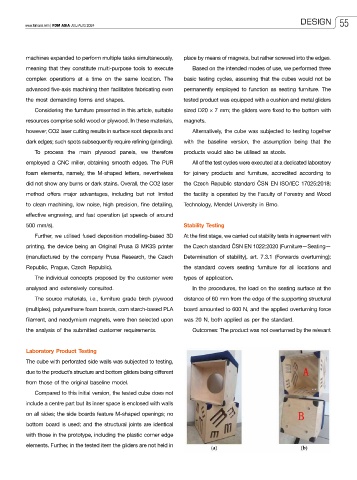
          The cube with perforated side walls was subjected to testing,
          due to the product’s structure and bottom gliders being different
          from those of the original baseline model.
            Compared to this initial version, the tested cube does not
          include a centre part but its inner space is enclosed with walls
          on all sides; the side boards feature M-shaped openings; no
          bottom board is used; and the structural joints are identical

          with those in the prototype, including the plastic corner edge
          elements. Further, in the tested item the gliders are not held in

