


Page 55 - FDMAsia JulAug 2024
P. 55
DESIGN       53
         www.fdmasia.com | FDM ASIA JUL/AUG 2024


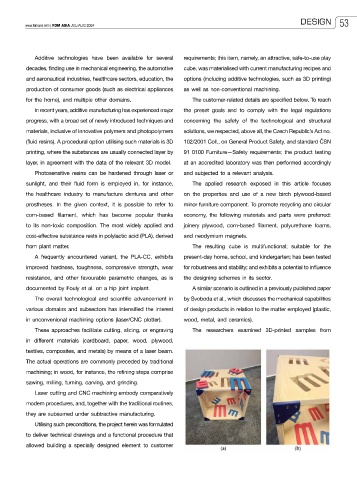
            Additive technologies have been available for several   requirements; this item, namely, an attractive, safe-to-use play
          decades, finding use in mechanical engineering, the automotive   cube, was materialised with current manufacturing recipes and
          and aeronautical industries, healthcare sectors, education, the   options (including additive technologies, such as 3D printing)
          production of consumer goods (such as electrical appliances   as well as non-conventional machining.

          for the home), and multiple other domains.            The customer-related details are specified below. To reach
            In recent years, additive manufacturing has experienced major   the preset goals and to comply with the legal regulations
          progress, with a broad set of newly introduced techniques and   concerning the safety of the  technological and structural
          materials, inclusive of innovative polymers and photopolymers   solutions, we respected, above all, the Czech Republic’s Act no.
          (fluid resins). A procedural option utilising such materials is 3D   102/2001 Coll., on General Product Safety, and standard ČSN
          printing, where the substances are usually connected layer by   91 0100 Furniture—Safety requirements; the product testing
          layer, in agreement with the data of the relevant 3D model.  at an accredited laboratory was then performed accordingly
            Photosensitive resins can be hardened through laser or   and subjected to a relevant analysis.
          sunlight, and their fluid form is employed in, for instance,   The applied research exposed in this article focuses

          the healthcare industry to manufacture dentures and other   on the properties and use of a new birch plywood-based
          prostheses.  In  the  given  context,  it  is  possible to  refer  to   minor furniture component. To promote recycling and circular
          corn-based filament, which has become popular thanks   economy, the following materials and parts were preferred:
          to  its  non-toxic  composition.  The  most  widely  applied  and   joinery  plywood,  corn-based filament,  polyurethane  foams,
          cost-effective substance rests in polylactic acid (PLA), derived   and neodymium magnets.
          from plant matter.                                    The resulting cube is multifunctional; suitable for the
            A frequently encountered variant, the PLA-CC, exhibits   present-day home, school, and kindergarten; has been tested

          improved hardness, toughness, compressive strength, wear   for robustness and stability; and exhibits a potential to influence
          resistance, and other favourable parametric changes, as is   the designing schemes in its sector.
          documented by Fouly et al. on a hip joint implant.    A similar scenario is outlined in a previously published paper
            The overall technological and scientific advancement in   by Svoboda et al., which discusses the mechanical capabilities
          various domains and subsectors has intensified the interest   of design products in relation to the matter employed (plastic,
          in unconvenional machining options (laser/CNC plotter).   wood, metal, and ceramics).
            These approaches facilitate cutting, slicing, or engraving   The researchers examined 3D-printed samples from
          in different materials (cardboard, paper, wood, plywood,
          textiles, composites, and metals) by means of a laser beam.

          The actual operations are commonly preceded by traditional
          machining; in wood, for instance, the refining steps comprise
          sawing, milling, turning, carving, and grinding.
            Laser cutting and CNC machining embody comparatively
          modern procedures, and, together with the traditional routines,
          they are subsumed under subtractive manufacturing.
            Utilising such preconditions, the project herein was formulated

          to deliver technical drawings and a functional procedure that
          allowed building a specially designed element to customer

