


Page 61 - FDMAsia JulAug 2024
P. 61
DESIGN       59
         www.fdmasia.com | FDM ASIA JUL/AUG 2024


          plywood boards, formaldehyde contents are specified as up   Germany, and some Russian-speaking countries, to provide
          to 8 mg/100 g of mass, according to EN 120 (an already   applicable examples.
          invalid standard that has been substituted with ČSN EN ISO   In France, products are tested according to EN ISO
          12460-5. Materials characterised in the class E2 are suitable   16000, A+ being the best rating [70]. In Germany, all products

          for outdoors only because the formaldehyde volume may   introduced to the market must be tested. Other states use a
          attain eight to 30 mg/100 g mass.                  recognised  label,  such  as  the  Finnish M1  certificate, which
            Another finding lies in that the European Commission   monitors the TVOC for more than 2000 items.
          has set a new limit for the concentration of formaldehyde in   Regarding the structure, strength, ruggedness, and stability,
          ‘ambient’ air: Regulation 2023/1464, published on 14 July 2023.   the product appears to be excessively massive to be used by
            This provision reduces the previous values to a half by   children, considering the 15 mm plywood. In further research,
          setting the  limit of  0.062 mg/cubic metre on the emissions,   we intend to examine the capabilities of 12 mm thick multiplex
          particularly with regard to wood-based products and furniture   plywood, reducing the overall weight of the basic element
          as possible ‘sources’ of formaldehyde.             down to approximately 5.0 kg.

            Currently, there is chipboard/plywood furniture on the   A potential  direction  for the future  investigation  may  lie
          European market that has not been treated with formaldehyde   in other items where the technologies involved (CO2 laser,
          or even has lower formaldehyde emissions than wood.   3D printing, CNC milling) at both the development and the
            The manufacturer or seller of such furniture shall provide   application stages facilitate design progression. Using the
          an indication of the emission class. Each product and plywood   combination  of  options  specified  herein  often  results  in  a
          material  has to be  described  with  a  technical data  sheet   multitude of convenient materials, new shape possibilities,
          containing information on the properties and applicability of   innovative structural solutions, different designs, and a higher

          the product.                                       product strength.
            The Multiplex birch plywood complies with the E1 emission   Utilising laser technology (PUR perforation cutting) together
          class;  the  central  Europe-based  company  Demos  Trade   with PUR foam and birch plywood multiplex delivers a final
          may serve in this context as a convenient reference subject,   product that supports and develops the motor skills of pre-
          declaring that formaldehyde-free E0 plywood is available   school children. Here, the fact that (as a new direction for
          upon request (boards made from beech wood being the   the research) a similar solution could support fine motor skills
          most affordable ones).                             in pre-school children experiencing developmental dyspraxia
            An optional solution for the cube would rest in using beech   and/or related disorders should be seriously considered.
          plywood multiplex with an E0 emission class glue. To prevent

          the release of formaldehyde, all surfaces and edges of relevant
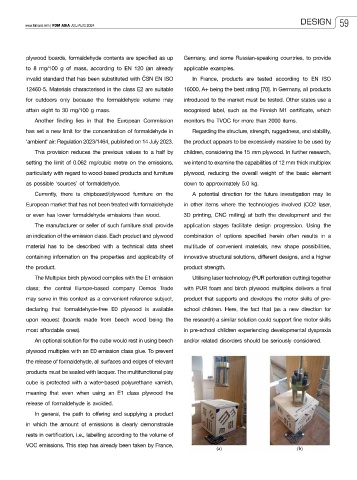
          products must be sealed with lacquer. The multifunctional play
          cube is protected with a water-based polyurethane varnish,
          meaning that even when using an E1 class plywood the
          release of formaldehyde is avoided.
            In general, the path to offering and supplying a product
          in which the amount of emissions is clearly demonstrable

          rests in certification, i.e., labelling according to the volume of
          VOC emissions. This step has already been taken by France,

