


Page 62 - FDMAsia JulAug 2024
P. 62
60    DESIGN                                                                      JUL/AUG 2024 FDM ASIA | www.fdmasia.com


                                                             via  enzymatic  hydrolysis  from  corn  starch);  importantly,  the
                                                             plastic is fully biodegradable.
                                                                The acid, however, despite being the most favoured option
                                                             for the purpose thanks to its non-toxic character, lack of printing

                                                             deformities, and easy recycling, is somewhat hampered by
                                                             its relatively low temperature resistance of up to 65 deg C.
                                                                In comparable materials, relevant deformations occur at
                                                             higher levels (ABS = 100 °C, PETG/HT-PETG = 110 °C). The
                                                             reason to substantiate the use of PLA filament rests in the
                                                             recyclability, ruggedness, and positional stability, the latter two
                                                             properties being ensured by the edge joint. The recycling is
                                                             commonly performed in industry-scale composting plants,
                                                             where the conditions allow bioplastics to decay.

                                                                From the child’s perspective, the most significant aspect
                                                             is the play factor, which, by extension, supports the motor
                                                             skills and helps to develop the overall set of abilities.
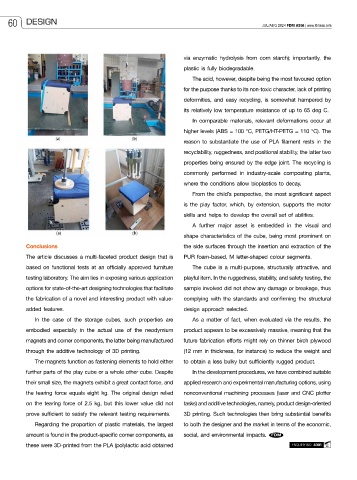
                                                                A further major asset is embedded in the visual and
                                                             shape characteristics of the cube, being most prominent on
          Conclusions                                        the side surfaces through the insertion and extraction of the
          The  article  discusses a  multi-faceted  product  design  that is   PUR foam-based, M letter-shaped colour segments.

          based  on  functional  tests  at  an  officially  approved  furniture   The cube is a multi-purpose, structurally attractive, and
          testing laboratory. The aim lies in exposing various application   playful item. In the ruggedness, stability, and safety testing, the
          options for state-of-the-art designing technologies that facilitate   sample involved did not show any damage or breakage, thus
          the fabrication of a novel and interesting product with value-  complying with the standards and confirming the structural
          added features.                                    design approach selected.
            In the case of the storage cubes, such properties are   As a matter of fact, when evaluated via the results, the
          embodied especially in the actual use of the neodymium   product appears to be excessively massive, meaning that the
          magnets and corner components, the latter being manufactured   future fabrication efforts might rely on thinner birch plywood
          through the additive technology of 3D printing.    (12 mm in thickness, for instance) to reduce the weight and

            The magnets function as fastening elements to hold either   to obtain a less bulky but sufficiently rugged product.
          further parts of the play cube or a whole other cube. Despite   In the development procedures, we have combined suitable
          their small size, the magnets exhibit a great contact force, and   applied research and experimental manufacturing options, using
          the tearing force equals eight kg. The original design relied   nonconventional machining processes (laser and CNC plotter
          on the tearing force of 2.5 kg, but this lower value did not   tasks) and additive technologies, namely, product design-oriented
          prove sufficient to satisfy the relevant testing requirements.   3D printing. Such technologies then bring substantial benefits
            Regarding the proportion of plastic materials, the largest   to both the designer and the market in terms of the economic,

          amount is found in the product-specific corner components, as   social, and environmental impacts.  FDM
          these were 3D-printed from the PLA (polylactic acid obtained                          ENQUIRY NO. 4301

