


Page 42 - FDMAsia JulAug 2025
P. 42
40   TECHNOLOGY                                                                   JUL/AUG 2025 FDM ASIA | www.fdmasia.com


                                                             multi-directional failure risks, improving structural safety and
                                                             durability.
                                                                This performance breakthrough extends its  applications
                                                             beyond traditional longitudinal load-bearing structures to

                                                             scenarios requiring transverse and complex mechanical
                                                             properties. To explore the full potential of the self-densified
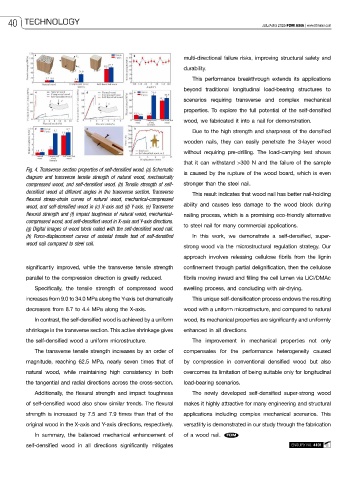
                                                             wood, we fabricated it into a nail for demonstration.
                                                                Due to the high strength and sharpness of the densified
                                                             wooden nails, they can easily penetrate the 3-layer wood
                                                             without requiring pre-drilling. The load-carrying test shows
                                                             that it can withstand >300 N and the failure of the sample
          Fig. 4. Transverse section properties of self-densified wood. (a) Schematic   is caused by the rupture of the wood board, which is even
          diagram  and  transverse  tensile  strength  of  natural  wood,  mechanically
          compressed wood, and self-densified wood. (b) Tensile strength of self-  stronger than the steel nail.
          densified wood at different angles in the transverse section. Transverse   This result indicates that wood nail has better nail-holding
          flexural stress-strain curves of natural wood, mechanical-compressed
          wood, and self-densified wood in (c) X-axis and (d) Y-axis. (e) Transverse   ability and causes less damage to the wood block during
          flexural strength and (f) impact toughness of natural wood, mechanical-  nailing process, which is a promising eco-friendly alternative
          compressed wood, and self-densified wood in X-axis and Y-axis directions.   to steel nail for many commercial applications.
          (g) Digital images of wood block nailed with the self-densified wood nail.
          (h) Force-displacement curves of uniaxial tensile test of self-densified   In this work, we demonstrate a self-densified, super-
          wood nail compared to steel nail.
                                                             strong wood via the microstructural regulation strategy. Our
                                                             approach involves releasing cellulose fibrils from the lignin

          significantly improved, while the transverse tensile strength   confinement through partial delignification, then the cellulose
          parallel to the compression direction is greatly reduced.   fibrils moving inward and filling the cell lumen via LiCl/DMAc
            Specifically, the tensile  strength  of compressed  wood   swelling process, and concluding with air-drying.
          increases from 9.0 to 34.0 MPa along the Y-axis but dramatically   This unique self-densification process endows the resulting
          decreases from 8.7 to 4.4 MPa along the X-axis.    wood with a uniform microstructure, and compared to natural
            In contrast, the self-densified wood is achieved by a uniform   wood, its mechanical properties are significantly and uniformly
          shrinkage in the transverse section. This active shrinkage gives   enhanced in all directions.
          the self-densified wood a uniform microstructure.     The  improvement  in  mechanical properties  not  only
            The transverse tensile strength increases by an order of   compensates for the performance heterogeneity caused

          magnitude, reaching 62.5 MPa, nearly seven times that of   by compression in conventional densified wood but also
          natural wood, while maintaining high consistency in both   overcomes its limitation of being suitable only for longitudinal
          the tangential and radial directions across the cross-section.   load-bearing scenarios.
            Additionally, the flexural strength and impact toughness   The newly developed self-densified super-strong wood
          of self-densified wood also show similar trends. The flexural   makes it highly attractive for many engineering and structural
          strength is increased by 7.5 and 7.9 times than that of the   applications including complex mechanical scenarios. This
          original wood in the X-axis and Y-axis directions, respectively.   versatility is demonstrated in our study through the fabrication

            In summary, the balanced mechanical enhancement of   of a wood nail.  FDM
          self-densified wood in all directions significantly mitigates                         ENQUIRY NO. 4101

