


Page 41 - FDMAsia JulAug 2025
P. 41
TECHNOLOGY           39
         www.fdmasia.com | FDM ASIA JUL/AUG 2025


          flexural strength is relatively lower (~96 MPa); however, when
          the bending load axis is parallel to the non-compression
          direction, its strength significantly increases to ~328 MPa.
            The  remarkable  improvement  of  mechanical  properties

          is attributed to the unique self-densification strengthening at
          multiple-scales. Self-densified wood maintains a highly densely
          ordered alignment structure.
            During the densification process and tensile fracture surface,
          highly aligned nanocellulose fibres were densely packed and
          arranged longitudinally, significantly increasing the interfacial
          area among nanofibers.
            At the molecular scale, during the swelling and dehydration
          processes, the abundant hydroxyl groups in cellulose molecular

          chains facilitate numerous cycles of hydrogen bond formation,
          breaking, and reformation.
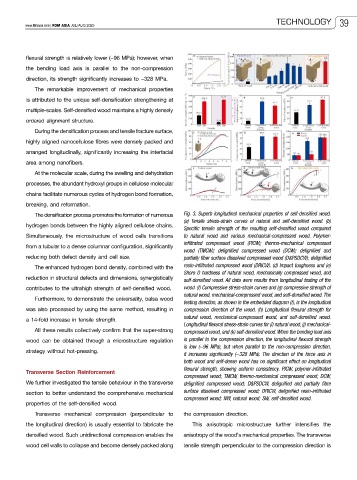
            The densification process promotes the formation of numerous   Fig. 3. Superb longitudinal mechanical properties of self-densified wood.
                                                             (a)  Tensile  stress-strain  curves  of  natural  and  self-densified  wood.  (b)
          hydrogen bonds between the highly aligned cellulose chains.
                                                             Specific  tensile  strength  of  the  resulting  self-densified  wood  compared
          Simultaneously, the microstructure of wood cells transitions   to natural wood and various mechanical-compressed wood. Polymer-
                                                             infiltrated compressed wood (PICW); thermo-mechanical compressed
          from a tubular to a dense columnar configuration, significantly
                                                             wood (TMCW); delignified compressed wood (DCW); delignified and
          reducing both defect density and cell size.        partially fiber surface dissolved compressed wood (D&PSDCW); delignified
            The enhanced hydrogen bond density, combined with the   resin-infiltrated compressed wood (DRICW). (d) Impact toughness and (e)
                                                             Shore D hardness of natural wood, mechanically compressed wood, and
          reduction in structural defects and dimensions, synergistically   self-densified wood. All data were results from longitudinal testing of the
          contributes to the ultrahigh strength of self-densified wood.   wood. (f) Compressive stress-strain curves and (g) compressive strength of
                                                             natural wood, mechanical-compressed wood, and self-densified wood. The
            Furthermore, to demonstrate the universality, balsa wood
                                                             testing direction, as shown in the embedded diagram (f), is the longitudinal
          was also processed by using the same method, resulting in   compression direction of the wood. (h) Longitudinal flexural strength for
          a 14-fold increase in tensile strength.            natural wood, mechanical-compressed wood, and self-densified wood.
                                                             Longitudinal flexural stress-strain curves for (i) natural wood, (j) mechanical-
            All these results collectively confirm that the super-strong   compressed wood, and (k) self-densified wood. When the bending load axis
          wood can be obtained through a microstructure regulation   is parallel to the compression direction, the longitudinal flexural strength
                                                             is low (~96 MPa), but when parallel to the non-compression direction,
          strategy without hot-pressing.
                                                             it  increases  significantly (~328 MPa). The direction  of the force axis in
                                                             both wood and self-dense wood has no significant effect on longitudinal
                                                             flexural strength, showing uniform consistency. PICW, polymer-infiltrated
          Transverse Section Reinforcement
                                                             compressed wood; TMCW, thermo-mechanical compressed wood; DCW,
          We further investigated the tensile behaviour in the transverse   delignified compressed wood; D&PSDCW, delignified and partially fibre
          section to better understand the comprehensive mechanical   surface dissolved compressed wood; DRICW, delignified resin-infiltrated
                                                             compressed wood; NW, natural wood; SW, self-densified wood.
          properties of the self-densified wood.
            Transverse mechanical compression (perpendicular to   the compression direction.
          the longitudinal direction) is usually essential to fabricate the   This anisotropic microstructure further intensifies the

          densified wood. Such unidirectional compression enables the   anisotropy of the wood's mechanical properties. The transverse
          wood cell walls to collapse and become densely packed along   tensile strength perpendicular to the compression direction is

