


Page 39 - FDMAsia JulAug 2025
P. 39
TECHNOLOGY           37
         www.fdmasia.com | FDM ASIA JUL/AUG 2025


            The charpy impact properties of the wood were tested
          using pendulum impact testing machine and the general size
          of samples were 60 mm by 10 mm by 3 mm.
            For all the tests, at least five specimens of each group

          were  tested, and  the average  values  were reported  with
          their  standard  deviations.  The  shear  tests  and  pullout  tests
          of wood nails were performed using a universal mechanical
          testing machine.
            For shear tests, the nails were hammered into a 3-layer
          basswood block (thickness of each layer: 1 cm).
            For pullout tests, the nails were hammered into a basswood
          blocks with the depth of 1 cm.


          Fabrication And Microstructure Analysis
          We synthesised the super-strong, self-densified wood via the
          microstructural regulation strategy. After regulation, natural
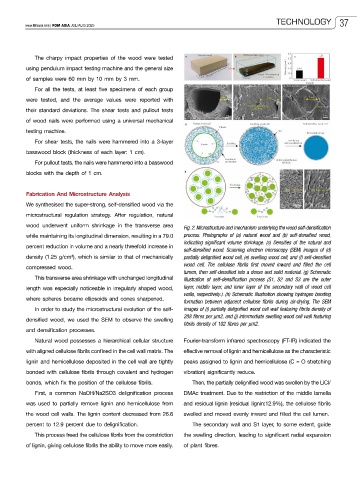
          wood underwent  uniform  shrinkage in the transverse area   Fig. 2. Microstructure and mechanism underlying the wood self-densification
          while maintaining its longitudinal dimension, resulting in a 79.0   process. Photographs of (a) natural wood and (b) self-densified wood,
                                                             indicating significant volume shrinkage. (c) Densities of the natural and
          percent reduction in volume and a nearly threefold increase in
                                                             self-densified  wood.  Scanning  electron  microscopy  (SEM)  images  of  (d)
          density (1.25 g/cm³), which is similar to that of mechanically   partially delignified wood cell, (e) swelling wood cell, and (f) self-densified

          compressed wood.                                   wood  cell.  The cellulose fibrils first  moved inward and  filled the cell
                                                             lumen, then self-densified into a dense and solid material. (g) Schematic
            This transverse area shrinkage with unchanged longitudinal   illustration  of  self-densification  process  (S1,  S2  and  S3  are  the  outer
          length was especially noticeable in irregularly shaped wood,   layer, middle layer, and inner layer of the secondary wall of wood cell
                                                             walls, respectively.). (h) Schematic illustration showing hydrogen bonding
          where spheres became ellipsoids and cones sharpened.
                                                             formation between adjacent cellulose fibrils during air-drying. The SEM
            In order to study the microstructural evolution of the self-  images of (i) partially delignified wood cell wall featuring fibrils density of
                                                             288 fibres per μm2, and (j) intermediate swelling wood cell wall featuring
          densified wood, we used the SEM to observe the swelling
                                                             fibrils density of 102 fibres per μm2.
          and densification processes.
            Natural wood possesses a hierarchical cellular structure   Fourier-transform infrared spectroscopy (FT-IR) indicated the
          with aligned cellulose fibrils confined in the cell wall matrix. The   effective removal of lignin and hemicellulose as the characteristic

          lignin and hemicellulose deposited in the cell wall are tightly   peaks assigned to lignin and hemicellulose (C = O stretching
          bonded with cellulose fibrils through covalent and hydrogen   vibration) significantly reduce.
          bonds, which fix the position of the cellulose fibrils.   Then, the partially delignified wood was swollen by the LiCl/
            First, a common NaOH/Na2SO3 delignification process   DMAc treatment. Due to the restriction of the middle lamella
          was used to partially remove lignin and hemicellulose from   and residual lignin (residual lignin:12.9%), the cellulose fibrils
          the wood cell walls. The lignin content decreased from 26.6   swelled and moved evenly inward and filled the cell lumen.
          percent to 12.9 percent due to delignification.       The secondary wall and S1 layer, to some extent, guide

            This process freed the cellulose fibrils from the constriction   the swelling direction, leading to significant radial expansion
          of lignin, giving cellulose fibrils the ability to move more easily.   of plant fibres.

