


Page 37 - FDMAsia JulAug 2025
P. 37
TECHNOLOGY           35
         www.fdmasia.com | FDM ASIA JUL/AUG 2025


          packed along fibre direction.                      flexural performance, with the longitudinal flexural strength
            The anisotropic structure further exacerbates the directional   approaching 400 MPa.
          differences in the mechanical properties of wood. Compression   This represents a significant advantage over compressed
          densification significantly improves the longitudinal tensile   wood, where the longitudinal flexural strength varies considerably

          strength of wood (compressed wood >> natural wood),   depending on whether the load axis is aligned with the
          and also enhances the transverse tensile strength when   compression or non-compression direction (96 MPa vs. ~400
          perpendicular to the compression direction (compressed wood   MPa).
          >> natural wood).                                     The resulting sustainable, super-strong wood emerges as a
            However, when the load axis is parallel to the compression   strong competitor for replacing traditional structural materials
          direction, the transverse tensile strength of compressed   such as metals and alloys.
          densified wood is considerably lower than that of natural
          wood, primarily due to microdefects, stress concentrations,   Chemicals And Raw Materials
          viscoelastic behaviour, and shape memory effects.  The basswood used in this study is scientifically classified as

            Additionally, compression densified wood faces issues such   Tilia amurensis. It primarily grows in Northeast China.
          as expansion and rebound along the compression direction.   The material was purchased from Oriental Aolong Wooden
            Although hydrogen bonding or chemical treatments can   Crafts. Chemicals used for removing lignin from wood were
          partially improve dimensional stability, the issue of low transverse   sodium hydroxide (NaOH), and sodium sulphite (Na2SO3),
          tensile strength in the compression direction persists, limiting   both of which were purchased from Sinopharm Chemical
          its application in complex mechanical environments.   Reagent. The anhydrous lithium chloride (LiCl) was purchased
            Therefore, the development of a new isotropic densification   from Xilong Scientific. The solvents used included N,N-

          technology that improves the mechanical properties and   dimethylacetamide (purchased from Sinopharm Chemical
          dimensional stability of wood in all directions is key to   Reagent) and deionised water.
          addressing this problem and will open new avenues for the
          broader application of wood.
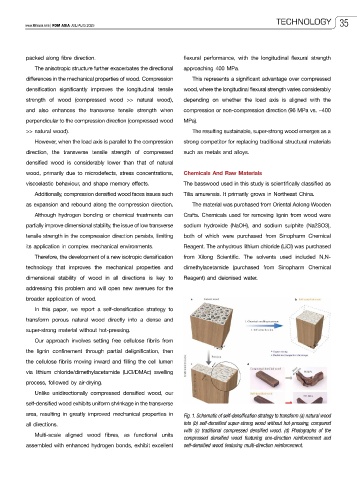
            In this paper, we report a self-densification strategy to
          transform  porous  natural  wood  directly  into  a  dense  and
          super-strong material without hot-pressing.
            Our approach involves setting free cellulose fibrils from
          the lignin confinement through partial delignification, then

          the cellulose fibrils moving inward and filling the cell lumen
          via lithium chloride/dimethylacetamide (LiCl/DMAc) swelling
          process, followed by air-drying.
            Unlike unidirectionally compressed densified wood, our
          self-densified wood exhibits uniform shrinkage in the transverse
          area, resulting in greatly improved mechanical properties in   Fig. 1. Schematic of self-densification strategy to transform (a) natural wood
          all directions.                                    into (b) self-densified super-strong wood without hot-pressing, compared
                                                             with  (c)  traditional  compressed  densified wood. (d) Photographs  of  the
            Multi-scale aligned wood fibres, as functional units
                                                             compressed densified wood featuring one-direction reinforcement and
          assembled with enhanced hydrogen bonds, exhibit excellent   self-densified wood featuring multi-direction reinforcement.

