


Page 47 - FDMAsia JulAug 2025
P. 47
MATERIALS         45
         www.fdmasia.com | FDM ASIA JUL/AUG 2025


            Following Yin’s methodology for multiple-case studies,   pellets.
          this research employed an exploratory embedded case study   2.  Ori Living—Smart modular furniture with IoT-based actuation
          design. This approach enabled investigation into a complex,   systems.
          emerging innovation landscape where variables such as   3.  Forust—3D  printing  using  reconstituted  wood  waste

          material characteristics, technology adoption, and management   including pellet feedstock.
          practices intersect.                               4.  IKEA x Little Sun—Sustainable furniture integrating solar-
            The rationale for using qualitative case studies included   powered smart modules and recycled materials.
          the following:
          •  Capturing context-dependent knowledge in real-world   These cases did not uniformly use raw wood pellets,
            settings;                                        but  were  selected for their  relevance  in demonstrating  how
          •  Exploring emerging technological integrations where   repurposed wood waste, smart modules, and quality systems
            quantitative data were limited;                  converge in practice.
          •  Understanding stakeholder interactions and strategic   These selection criteria were designed to comprehensively

            processes.                                       evaluate projects across four key dimensions: material
                                                             advancement, intelligent integration, quality assurance, and
            The research was grounded in a theoretical integration   sustainability leadership.
          framework that combined the following:                Each dimension reflected an essential pillar of innovation
          •  Sustainable  Materials  Theory  (repurposed  biomass  into   that aligned with contemporary demands for eco-conscious,
            functional composites);                          smart, and reliable solutions. Projects that met or exceeded
          •  Product-Service Systems (PSS) and IoT-based smart   expectations in all four categories represented the forefront

            innovation;                                      of  sustainable  industrial design and  responsible production
          •  TQM (process-oriented innovation governance).   practices.
                                                                A total of 21 unique data sources were analysed,
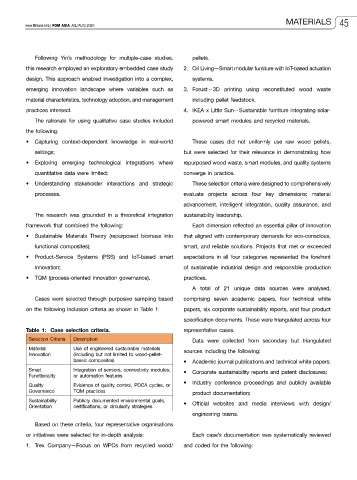
            Cases were selected through purposive sampling based   comprising seven academic papers, four technical white
          on the following inclusion criteria as shown in Table 1:  papers, six corporate sustainability reports, and four product
                                                             specification documents. These were triangulated across four
          Table 1:  Case selection criteria.                 representative cases.
          Selection Criteria  Description                       Data were collected from secondary but triangulated
          Material       Use of engineered sustainable materials   sources including the following:
          Innovation     (including but not limited to wood-pellet-
                         based composites)                   •  Academic journal publications and technical white papers;
          Smart          Integration of sensors, connectivity modules,   •  Corporate sustainability reports and patent disclosures;
          Functionality  or automation features
                                                             •  Industry conference proceedings and publicly available
          Quality        Evidence of quality control, PDCA cycles, or
          Governance     TQM practices                          product documentation;
          Sustainability   Publicly documented environmental goals,   •  Official websites and media interviews with design/
          Orientation    certifications, or circularity strategies
                                                                engineering teams.
            Based on these criteria, four representative organisations

          or initiatives were selected for in-depth analysis:   Each case’s documentation was systematically reviewed
          1.  Trex Company—Focus on WPCs from recycled wood/  and coded for the following:

