


Page 19 - FDMAsia JanFeb 2025
P. 19
MARKET BEATS           17
         www.fdmasia.com | FDM ASIA JAN/FEB 2025


          added Markowitz.
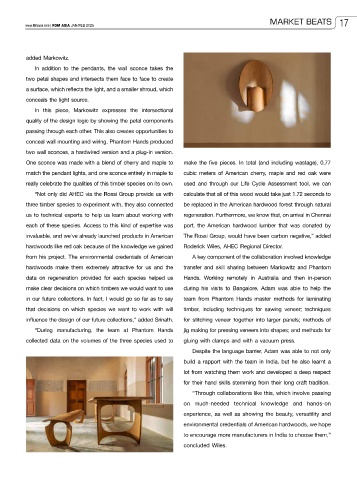
            In addition to the pendants, the wall sconce takes the
          two petal shapes and intersects them face to face to create
          a surface, which reflects the light, and a smaller shroud, which

          conceals the light source.
            In this piece, Markowitz expresses the intersectional
          quality of the design logic by showing the petal components
          passing through each other. This also creates opportunities to
          conceal wall mounting and wiring. Phantom Hands produced
          two wall sconces, a hardwired version and a plug-in version.
          One sconce was made with a blend of cherry and maple to   make the five pieces. In total (and including wastage), 0.77
          match the pendant lights, and one sconce entirely in maple to   cubic meters of American cherry, maple and red oak were
          really celebrate the qualities of this timber species on its own.  used and through our Life Cycle Assessment tool, we can

            “Not only did AHEC via the Rossi Group provide us with   calculate that all of this wood would take just 1.72 seconds to
          three timber species to experiment with, they also connected   be replaced in the American hardwood forest through natural
          us to technical experts to help us learn about working with   regeneration. Furthermore, we know that, on arrival in Chennai
          each of these species. Access to this kind of expertise was   port, the American hardwood lumber that was donated by
          invaluable, and we've already launched products in American   The Rossi Group, would have been carbon negative,” added
          hardwoods like red oak because of the knowledge we gained   Roderick Wiles, AHEC Regional Director.
          from his project. The environmental credentials of American   A key component of the collaboration involved knowledge

          hardwoods make them extremely attractive for us and the   transfer and skill sharing between Markowitz and Phantom
          data on regeneration provided for each species helped us   Hands. Working remotely in Australia and then in-person
          make clear decisions on which timbers we would want to use   during  his  visits  to  Bangalore,  Adam  was  able  to  help  the
          in our future collections. In fact, I would go so far as to say   team from Phantom Hands master methods for laminating
          that decisions on which species we want to work with will   timber, including techniques for sawing veneer; techniques
          influence the design of our future collections,” added Srinath.  for stitching veneer together into larger panels; methods of
            “During manufacturing, the team at Phantom Hands   jig making for pressing veneers into shapes; and methods for
          collected data on the volumes of the three species used to   gluing with clamps and with a vacuum press.
                                                                Despite the language barrier, Adam was able to not only

                                                             build a  rapport with the team in India, but he also learnt a
                                                             lot from watching them work and developed a deep respect
                                                             for their hand skills stemming from their long craft tradition.
                                                                “Through collaborations like this, which involve passing
                                                             on much-needed technical knowledge and hands-on
                                                             experience, as well as showing the beauty, versatility and
                                                             environmental credentials of American hardwoods, we hope

                                                             to encourage more manufacturers in India to choose them,”
                                                             concluded Wiles.

