


Page 42 - FDMAsia MayJun2024
P. 42
40   TECHNOLOGY                                                                   MAY/JUN 2024 FDM ASIA | www.fdmasia.com


         Ksenia Chernaya                                     such as the automotive, healthcare, architecture, and furniture
                                                             industries. It enables the reverse engineering of complex
                                                             curved surfaces and the preparation of production systems.
                                                                Additionally, 3D scanning is used in the industry to develop

                                                             business attire patterns by integrating 3D customer data
                                                             obtained through the scanning process.
                                                                Three-dimensional scanning is used to digitalise furniture
                                                             parts when there is a lack of technical documentation. This
                                                             scanning application is presented in the second case study.
                                                                The use of 3D scanners also allows the analysis of deviations
                                                             in model surfaces, dimensional deviations, and geometric
                                                             tolerances (second and third case study). This information
                                                             helps to maintain production quality by controlling geometry

                                                             errors in the production process.
                                                                Smart factories can enhance quality and gain a competitive
          (3D printing) and reverse engineering (based on 3D scanning)   advantage using 3D metrological data.
          can significantly influence and modernise old manufacturing   The fourth analysed case study enables us to obtain
          processes like sand casting.                       geometric documentation of objects within history and the arts,
                                                             allowing conservation and safeguarding of cultural heritage.
          3D Scanning, Reverse Engineering & 3D Printing        The application of 3D digital technologies in the conservation

          The first analysed case study discusses using 3D scanning   of cultural heritage has proven to help improve the collection,
          to  digitalise  initial  concept  designs  created  by  designers  or   storage, and consultation of information and data related to
          architects. Hand-created designs are scanned into STL 3D   diagnostic and restoration work.
          models for manufacturing.                             Therefore, 3D scanning can be utilised to document furniture
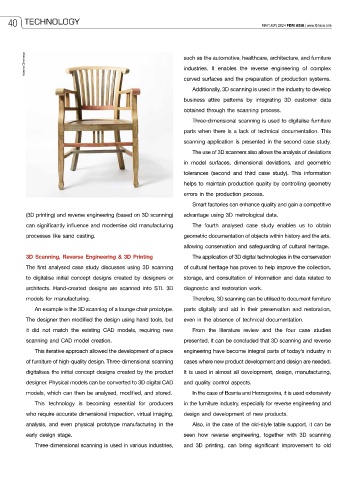
            An example is the 3D scanning of a lounge chair prototype.   parts digitally and aid in their preservation and restoration,
          The designer then modified the design using hand tools, but   even in the absence of technical documentation.
          it did not match the existing CAD models, requiring new   From the literature review and the four case studies
          scanning and CAD model creation.                   presented, it can be concluded that 3D scanning and reverse
            This iterative approach allowed the development of a piece   engineering have become integral parts of today’s industry in

          of furniture of high-quality design. Three-dimensional scanning   cases where new product development and design are needed.
          digitalises the initial concept designs created by the product   It is used in almost all development, design, manufacturing,
          designer. Physical models can be converted to 3D digital CAD   and quality control aspects.
          models, which can then be analysed, modified, and stored.   In the case of Bosnia and Herzegovina, it is used extensively
            This technology is becoming essential for producers   in the furniture industry, especially for reverse engineering and
          who require accurate dimensional inspection, virtual imaging,   design and development of new products.
          analysis, and even physical prototype manufacturing in the   Also, in the case of the old-style table support, it can be

          early design stage.                                seen how reverse engineering, together with 3D scanning
            Three-dimensional scanning is used in various industries,   and  3D  printing,  can  bring  significant  improvement  to  old

