


Page 40 - FDMAsia MayJun2024
P. 40
38   TECHNOLOGY                                                                   MAY/JUN 2024 FDM ASIA | www.fdmasia.com


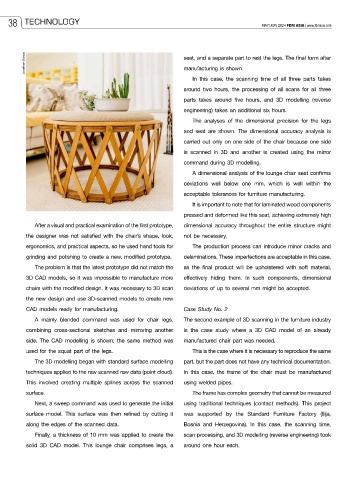
         Jonathan Borba                                      seat, and a separate part to rest the legs. The final form after
                                                             manufacturing is shown.
                                                                In this case, the scanning time of all three parts takes
                                                             around two hours, the processing of all scans for all three

                                                             parts  takes  around  five  hours,  and  3D  modelling  (reverse
                                                             engineering) takes an additional six hours.
                                                                The analyses of the dimensional precision for the legs
                                                             and seat are shown. The dimensional accuracy analysis is
                                                             carried out only on one side of the chair because one side
                                                             is scanned in 3D and another is created using the mirror
                                                             command during 3D modelling.
                                                                A dimensional analysis of the lounge chair seat confirms
                                                             deviations well below one mm, which is well within the

                                                             acceptable tolerances for furniture manufacturing.
                                                                It is important to note that for laminated wood components
                                                             pressed and deformed like this seat, achieving extremely high
            After a visual and practical examination of the first prototype,   dimensional accuracy throughout the entire structure might
          the designer was not satisfied with the chair’s shape, look,   not be necessary.
          ergonomics, and practical aspects, so he used hand tools for   The production process can introduce minor cracks and
          grinding and polishing to create a new, modified prototype.   delaminations. These imperfections are acceptable in this case,

            The problem is that the latest prototype did not match the   as  the  final  product  will  be  upholstered  with  soft  material,
          3D CAD models, so it was impossible to manufacture more   effectively hiding them. In such components, dimensional
          chairs with the modified design. It was necessary to 3D scan   deviations of up to several mm might be accepted.
          the new design and use 3D-scanned models to create new
          CAD models ready for manufacturing.                Case Study No. 2
            A mainly blended command was used for chair legs,   The second example of 3D scanning in the furniture industry
          combining cross-sectional sketches and mirroring another   is the case study where a 3D CAD model of an already
          side.  The  CAD  modelling  is  shown;  the  same  method  was   manufactured chair part was needed.
          used for the squat part of the legs.                  This is the case where it is necessary to reproduce the same

            The 3D modelling began with standard surface modelling   part, but the part does not have any technical documentation.
          techniques applied to the raw scanned raw data (point cloud).   In this case, the frame of the chair must be manufactured
          This  involved  creating  multiple  splines across the scanned   using welded pipes.
          surface.                                              The frame has complex geometry that cannot be measured
            Next, a sweep command was used to generate the initial   using traditional techniques (contact methods). This project
          surface model. This surface was then refined by cutting it   was supported by the Standard Furniture Factory (Ilija,
          along the edges of the scanned data.               Bosnia and Herzegovina). In this case, the scanning time,

            Finally, a thickness of 10 mm was applied to create the   scan processing, and 3D modelling (reverse engineering) took
          solid 3D CAD model. This lounge chair comprises legs, a   around one hour each.

