


Page 40 - FDMAsia JanFeb 2025
P. 40
38   TECHNOLOGY                                                                    JAN/FEB 2025 FDM ASIA | www.fdmasia.com


         Opt Lasers


          differences in the elemental composition between the surface   sample. Another advantage of the method is the possibility of
          layers of wood impregnated with graphene oxide and native   conducting analyses on practically all objects, whether solids,
          wood.                                              liquids, or gases.
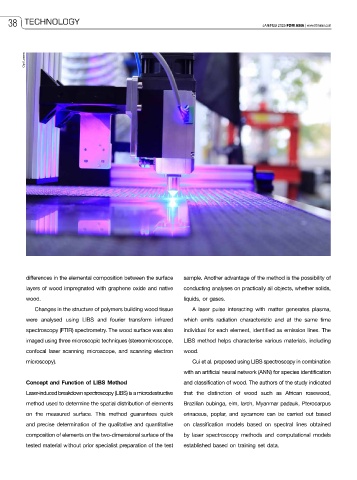
            Changes in the structure of polymers building wood tissue   A laser pulse interacting with matter generates plasma,
          were analysed using LIBS and fourier transform infrared   which emits radiation characteristic and at the same time
          spectroscopy (FTIR) spectrometry. The wood surface was also   individual for each element, identified as emission lines. The
          imaged using three microscopic techniques (stereomicroscope,   LIBS method helps characterise various materials, including
          confocal laser scanning microscope, and scanning electron   wood.

          microscopy).                                          Cui et al. proposed using LIBS spectroscopy in combination
                                                             with an artificial neural network (ANN) for species identification
          Concept and Function of LIBS Method                and classification of wood. The authors of the study indicated
          Laser-induced breakdown spectroscopy (LIBS) is a microdestructive   that the distinction of wood such as African rosewood,
          method used to determine the spatial distribution of elements   Brazilian bubinga, elm, larch, Myanmar padauk, Pterocarpus
          on the measured surface. This method guarantees quick   erinaceus, poplar, and sycamore can be carried out based
          and precise determination of the qualitative and quantitative   on classification models based on spectral lines obtained

          composition of elements on the two-dimensional surface of the   by laser spectroscopy methods and computational models
          tested material without prior specialist preparation of the test   established based on training set data.

