


Page 52 - FDMAsia NovDec 2024
P. 52
50   MATERIALS                                                                    NOV/DEC 2024 FDM ASIA | www.fdmasia.com


         Andrii Shyp                                         geometric constraints  to  the  model  in  order  to control  how
                                                                The  software  allows  the  application  of  several  types  of

                                                             the material is removed.
                                                                All of them were tested in the early models, but, since

                                                             some of them did not show a significant optimisation or were
                                                             not pertinent to the tested model, only three were chosen for
                                                             the final analysis: “Planar symmetry”, “Rotational symmetry”,
                                                             “Point symmetry”. The “Planar symmetry” constraint forces
                                                             the optimised model to be symmetric about a specified plane,
                                                             the  “Rota-tional  symmetry”  constraint  forces  the  optimised
                                                             model to be symmetric about a specified axis and the “Point
                                                             symmetry”  constraint  forces  the  optimised  model  to  be
                                                             symmetric about a specified point.

          160 mm × 40 mm. The number of wooden samples used     Based on the laboratory tests carried out within the
          is 23. The discretisation of the model can be analysed in   current project, a Monte Carlo analysis was carried out using
          “discretisation of the model”.                     a proprietary script in which the material parameters were
            For the optimisation, the topological optimisation method   varied using the mean and the standard deviation resulting
          was chosen, blocking the areas of application of the conditions   from the laboratory tests.
          on the contour and the area of application of the uniform   For each model to which different geometric constraints
          pressure.                                          were applied, the script was applied to run 30 models with

            In the optimisation process, the finite element density   different mechanical parameters. The results were collected
          was allowed to vary between 1 and 0.001 with a maximum   in a database compared and contrasted.
          variation per analysis cycle of 0.25. Three de-sign response   In order to incorporate as close as possible the geometric
          functions have been defined, namely “Energy Stiffness Measure”,   results obtained by Monte-Carlo simulation, it was initially
          “Volume” and “Signed Von Mises Stress”.            proposed to use a generative machine learning model
            The objective of the optimisation was to minimise the design   (diffuser) which, starting from the synthetic data of each
          response values for “Volume”. The optimisation task initially   beam (opening, spans, loads), can generate topologically
          applied to the model was to limit the volume variation below   optimised glued laminated timber elements in elevation. The
          45 percent. Unfortunately, the software applied the 45 percent   first attempts resulted in a lack of alignment of the machine

          material reduction directly to the model and then reshaped   learning model.
          it in order to withstand the increased interior stresses, so it   Noting the lack of alignment of the generative model,
          was not a correct approach.                        another machine learning method took the place of the current
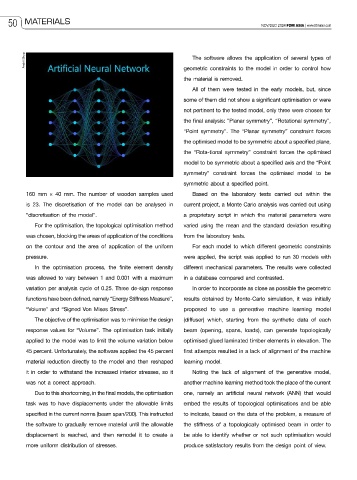
            Due to this shortcoming, in the final models, the optimisation   one, namely an artificial neural network (ANN) that would
          task was to have displacements under the allowable limits   embed the results of topological optimisations and be able
          specified in the current norms (beam span/200). This instructed   to indicate, based on the data of the problem, a measure of
          the software to gradually remove material until the allowable   the stiffness of a topologically optimised beam in order to

          displacement is  reached,  and  then  remodel it  to  create  a   be able to identify whether or not such optimisation would
          more uniform distribution of stresses.             produce satisfactory results from the design point of view.

