


Page 50 - FDMAsia NovDec 2024
P. 50
48   MATERIALS                                                                    NOV/DEC 2024 FDM ASIA | www.fdmasia.com


         Liji Jinaraj                                        ascertain the contact properties.
                                                                In terms of the wood species used, spruce was the best
                                                             solution considering that it is a common species used for the
                                                             realisation of glued laminated timber elements according to the

                                                             study of "Metamodel assisted optimisation of glued laminated
                                                             timber beams by using metaheuristic algorithms" from Pech,
                                                             S.,Kandler, G., Lukacevic, M. and Füss, J..
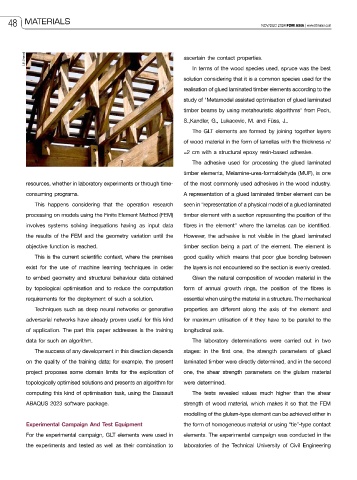
                                                                The GLT elements are formed by joining together layers
                                                             of wood material in the form of lamellas with the thickness
                                                             =2 cm with a structural epoxy resin-based adhesive.
                                                                The adhesive used for processing the glued laminated
                                                             timber elements, Melamine-urea-formaldehyde (MUF), is one
          resources, whether in laboratory experiments or through time-  of the most commonly used adhesives in the wood industry.

          consuming programs.                                A representation of a glued laminated timber element can be
            This happens considering that the operation research   seen in “representation of a physical model of a glued laminated
          processing on models using the Finite Element Method (FEM)   timber element with a section representing the position of the
          involves systems solving inequations having as input data   fibres in the element” where the lamellas can be identified.
          the results of the FEM and the geometry variation until the   However, the adhesive is not visible  in the  glued laminated
          objective function is reached.                     timber section being a part of the element. The element is
            This is the current scientific context, where the premises   good quality which means that poor glue bonding between

          exist for the use of machine learning techniques in order   the layers is not encountered so the section is evenly created.
          to embed geometry and structural behaviour data obtained   Given the natural composition of wooden material in the
          by topological optimisation and to reduce the computation   form of annual growth rings, the position of the fibres is
          requirements for the deployment of such a solution.   essential when using the material in a structure. The mechanical
            Techniques such as deep neural networks or generative   properties are different along the axis of the element and
          adversarial networks have already proven useful for this kind   for  maximum  utilisation  of  it  they  have  to  be  parallel  to  the
          of application. The part this paper addresses is the training   longitudinal axis.
          data for such an algorithm.                           The laboratory determinations were carried out in two
            The success of any development in this direction depends   stages: in the first one, the strength parameters of glued

          on the quality of the training data; for example, the present   laminated timber were directly determined, and in the second
          project proposes some domain limits for the exploration of   one,  the  shear  strength  parameters  on  the  glulam  material
          topologically optimised solutions and presents an algorithm for   were determined.
          computing this kind of optimisation task, using the Dassault   The tests revealed values much higher than the shear
          ABAQUS 2023 software package.                      strength of wood material, which makes it so that the FEM
                                                             modelling of the glulam-type element can be achieved either in
          Experimental Campaign And Test Equipment           the form of homogeneous material or using “tie”-type contact

          For the experimental campaign, GLT elements were used in   elements. The experimental campaign was conducted in the
          the experiments and tested as well as their combination to   laboratories of the Technical University of Civil Engineering

