


Page 49 - FDMAsia NovDec 2024
P. 49
MATERIALS         47
         www.fdmasia.com | FDM ASIA NOV/DEC 2024


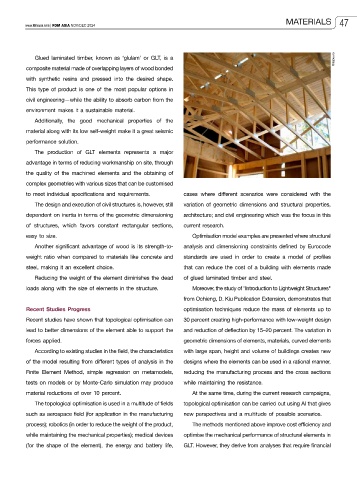
            Glued laminated timber, known as ‘glulam’ or GLT, is a                                            Riisipuuro
          composite material made of overlapping layers of wood bonded
          with synthetic resins and pressed into the desired shape.
          This type of product is one of the most popular options in

          civil engineering—while the ability to absorb carbon from the
          environment makes it a sustainable material.
            Additionally, the good mechanical properties of the
          material along with its low self-weight make it a great seismic
          performance solution.
            The production of GLT elements represents a major
          advantage in terms of reducing workmanship on site, through
          the quality of the machined elements and the obtaining of
          complex geometries with various sizes that can be customised

          to meet individual specifications and requirements.   cases where different scenarios were considered with the
            The design and execution of civil structures is, however, still   variation of geometric dimensions and structural properties,
          dependent on inertia in terms of the geometric dimensioning   architecture; and civil engineering which was the focus in this
          of structures, which favors constant rectangular sections,   current research.
          easy to size.                                         Optimisation model examples are presented where structural
            Another significant advantage of wood is its strength-to-  analysis and dimensioning constraints defined by Eurocode
          weight  ratio when compared to materials like  concrete and   standards are used in order to create a model of profiles

          steel, making it an excellent choice.              that  can  reduce  the  cost  of  a  building  with  elements  made
            Reducing the weight of the element diminishes the dead   of glued laminated timber and steel.
          loads along with the size of elements in the structure.  Moreover, the study of "Introduction to Lightweight Structures"
                                                             from Ochieng, D. Kiu Publication Extension, demonstrates that
          Recent Studies Progress                            optimisation techniques reduce the mass of elements up to
          Recent studies have shown that topological optimisation can   30 percent creating high-performance with low-weight design
          lead to better dimensions of the element able to support the   and reduction of deflection by 15–20 percent. The variation in
          forces applied.                                    geometric dimensions of elements, materials, curved elements
            According to existing studies in the field, the characteristics   with large span, height and volume of buildings creates new

          of the model resulting from different types of analysis in the   designs where the elements can be used in a rational manner,
          Finite Element Method, simple regression on metamodels,   reducing the manufacturing process and the cross sections
          tests on models or by Monte-Carlo simulation may produce   while maintaining the resistance.
          material reductions of over 10 percent.               At the same time, during the current research campaigns,
            The topological optimisation is used in a multitude of fields   topological optimisation can be carried out using AI that gives
          such as aerospace field (for application in the manufacturing   new perspectives and a multitude of possible scenarios.
          process); robotics (in order to reduce the weight of the product,   The methods mentioned above improve cost efficiency and

          while maintaining the mechanical properties); medical devices   optimise the mechanical performance of structural elements in
          (for  the  shape  of  the  element),  the  energy  and  battery  life,   GLT. However, they derive from analyses that require financial

