


Page 57 - FDMAsia SepOct 2025
P. 57
MATERIALS         55
         www.fdmasia.com | FDM ASIA SEP/OCT 2025


          out at 90 deg C for 30 min; after that, the suspension was   Table. Types and conditions of produced particleboards.
          cooled to 30 deg C and acidified with HNO3 to pH = 2.
                                                             LCB  Board Type  Hot-Pressing  Temperature/Time*  Designation
            Then, the mixture was filtered in a polypropylene filter bag                 °C/min
          with a fabric mesh size of 100 microns, rinsed with water, and   Crushing + SE  Conventional  160/20  WSSE

          filtered again to separate water-soluble KNO3 and to obtain        Mould                   WSSE-M
                                                             WS
          SA-containing binder with a solid content of 20 percent.  Milling + SA  Conventional  180/20  WSSA
                                                                             Mould                   WSSA-M
          Production And Evaluation Of Particleboards            Crushing + SE  Conventional  160/20  GASE
          Biobased particleboards were produced from LCB species using
                                                                             Mould                   GASE-M
          two manufacturing approaches: (1) binderless particleboards   GA
                                                                 Milling + SA  Conventional  180/20  GASA
          after SE treatment (SE-PB) and (2) milled particles bonded
                                                                             Mould                   GASA-M
          with SA binder (SA-PB).
                                                                 Crushing + SE  Conventional  165/20  SWSE
            The SE boards were produced only from SE-pretreated
                                                                             Mould                   SWSE-M
          LCB based on a previous study. The SA boards were   SW
                                                                 Milling + SA  Conventional  180/20  SWSA
          produced based on a previous study using 16%–18% (o.d.)
          of  SA  binder  added  to  prepared LCB  particles and  mixed      Mould                   SWSA-M
          to achieve homogenous furnish, then dried to MC of 2% ±   * The pressing time indicated here means holding in the press under
                                                             a certain pressure and includes nine minutes at the set temperature
          0.2% before the hot-pressing.                      and cooling down to 90 deg C.
            In addition to the conventional board type, the influence
          of  mould  (M)  hot-pressing  was  determined.  In  the  case  of   The obtained PBs were characterised according to the

          conventional pressing, the boards were produced with the   relevant standards by density, modulus of elasticity (MOE),
          measurements of 450 mm × 900 mm, from which another   and modulus of rupture (MOR) in the three-point bending
          four board samples were cut with the measurements of 200   test, with tensile strength perpendicular to the plane of the
          mm × 400 mm.                                       board (IB), and thickness swelling/water absorption (TS/WA)
            The M-boards were hot-pressed in the specific mould   after the immersion in water for 24 h.
          made from aluminium alloy with the inner measurements of   Mechanical tests (MOE, MOR, and IB) were performed on
          200 mm × 400 mm. The boards were hot-pressed, slightly   a ZWICK/Roell Z010 universal machine for testing resistance
          varying the temperature and time to achieve the set thickness   of materials.
          of 9.5 mm and density of 1200 kg/cubic metre.         The size of specimens was 200 mm × 50 mm for the

            The pressing cycle for all board types consisted of two   bending properties testing, and 50 mm × 50 mm for all other
          general steps: (1) pressing under the set temperature for 9   properties testing. Six specimens were determined in each
          min; and (2) cooling under a decreased pressure to achieve   test to calculate an average value of each property.
          the temperature of 90 deg C.                          The obtained board’s properties were compared with the
            The pressing pressure in the first step varied within 10   European requirements EN 312 for particleboards for use in
          ± 2 MPa to achieve the set thickness of the board and was   humid conditions (Type P3).
          diminished by approximately 20 percent in the second step.   The factors of the influence on the mean values of the tested

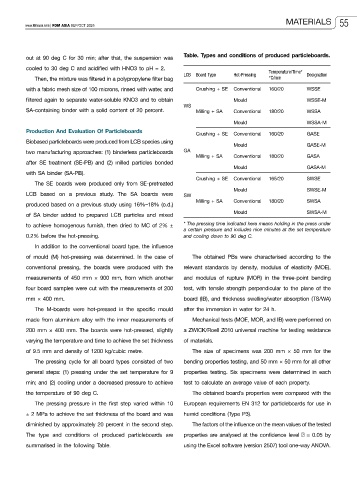
          The type and conditions of produced particleboards are   properties are analysed at the confidence level α = 0.05 by
          summarised in the following Table.                 using the Excel software (version 2507) tool one-way ANOVA.

