


Page 38 - FDMAsia Nov/Dec 2025
P. 38
36   TECHNOLOGY                                                                   NOV/DEC 2025 FDM ASIA | www.fdmasia.com


          economic, functional, and relational value.        panel of registered users. The platform recruited potential
            Once a sufficient chain of perceivedАvalue creation has   participants by sending out survey invitations—via email and
          been established, consumers are more likely to adopt a green   internal messaging systems—to a random sample.
          purchase attitude. Drawing on prior literature linking perceived   Stratified by age, gender, and geographic region, this sample

          value to green purchase intention, a conceptual model is   was designed to approximate the distribution of the national
          proposed with the following hypotheses:            population. Judgemental sampling was employed to obtain
            H1. Green perceived utility positively influences (a)   a valid sample and reduce non-response bias, ensuring that
          emotional value, (b) economic value, (c) functional value, and   participants could meaningfully evaluate product perceived
          (d) relational value.                              value, emotional value, and purchase intention—consistent
            H2. Green trust positively influences (a) emotional value, (b)   with methodological practices in sustainability research.
          economic value, (c) functional value, and (d) relational value.
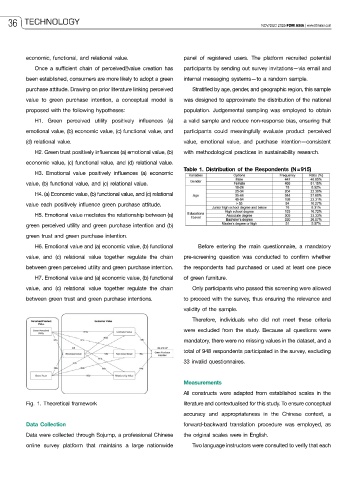
                                                             Table 1. Distribution of the Respondents (N = 915)
            H3. Emotional value positively influences (a) economic
          value, (b) functional value, and (c) relational value.

            H4. (a) Economic value, (b) functional value, and (c) relational
          value each positively influence green purchase attitude.
            H5. Emotional value mediates the relationship between (a)
          green perceived utility and green purchase intention and (b)
          green trust and green purchase intention.
            H6. Emotional value and (a) economic value, (b) functional     Before entering the main questionnaire, a mandatory
          value, and (c) relational value together regulate the chain   pre-screening  question  was  conducted  to  confirm  whether

          between green perceived utility and green purchase intention.  the respondents had purchased or used at least one piece
            H7. Emotional value and (a) economic value, (b) functional   of green furniture.
          value, and (c) relational value together regulate the chain   Only participants who passed this screening were allowed
          between green trust and green purchase intentions.  to proceed with the survey, thus ensuring the relevance and
                                                             validity of the sample.
                                                                Therefore, individuals who did not meet these criteria
                                                             were excluded from the study. Because all questions were
                                                             mandatory, there were no missing values in the dataset, and a
                                                             total of 948 respondents participated in the survey, excluding

                                                             33 invalid questionnaires.


                                                             Measurements
                                                             All  constructs  were  adapted  from  established  scales  in  the
          Fig. 1. Theoretical framework                      literature and contextualised for this study. To ensure conceptual
                                                             accuracy and appropriateness in the Chinese context, a
          Data Collection                                    forward-backward translation procedure was employed, as

          Data were collected through Sojump, a professional Chinese   the original scales were in English.
          online survey platform that maintains a large nationwide   Two language instructors were consulted to verify that each

