


Page 15 - FDMAsia SepOct 2024
P. 15
MARKET BEATS           13
         www.fdmasia.com | FDM ASIA SEP/OCT 2024


          Researchers                                                                                         rawpixel.com

          Develop New

          Gels To Protect

          Buildings During

          Wildfires


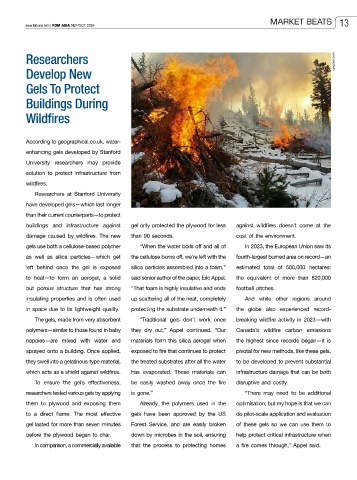
          According to geographical.co.uk, water-
          enhancing gels developed by Stanford
          University researchers may provide
          solution to protect infrastructure from
          wildfires.

            Researchers at Stanford University
          have developed gels—which last longer
          than their current counterparts—to protect
          buildings  and  infrastructure  against   gel only protected the plywood for less   against wildfires doesn’t come at the
          damage  caused by wildfires. The new   than 90 seconds.             cost of the environment.
          gels use both a cellulose-based polymer   “When the water boils off and all of   In 2023, the European Union saw its
          as  well  as  silica  particles—which  get   the cellulose burns off, we’re left with the   fourth-largest burned area on record—an

          left behind once the gel is exposed   silica particles assembled into a foam,”   estimated total of 500,000 hectares:
          to heat—to form an aerogel, a solid   said senior author of the paper, Eric Appel.   the  equivalent  of  more  than  820,000
          but porous structure that has strong   “That foam is highly insulative and ends   football pitches.
          insulating properties and is often used   up scattering all of the heat, completely   And while other regions around
          in space due to its lightweight quality.  protecting the substrate underneath it.”  the globe also experienced record-
            The gels, made from very absorbent   “Traditional gels don’t work once   breaking wildfire activity in 2023—with
          polymers—similar to those found in baby   they dry out,” Appel continued. “Our   Canada’s wildfire carbon emissions
          nappies—are mixed with water and   materials form this silica aerogel when   the highest since records began—it is
          sprayed onto a building. Once applied,   exposed to fire that continues to protect   pivotal for new methods, like these gels,

          they swell into a gelatinous-type material,   the treated substrates after all the water   to be developed to prevent substantial
          which acts as a shield against wildfires.  has evaporated. These materials can   infrastructure damage that can be both
            To ensure the gel’s effectiveness,   be easily washed  away  once the fire   disruptive and costly.
          researchers tested various gels by applying   is gone.”                “There may need to be additional
          them to plywood and exposing them    Already, the polymers used in the   optimisation, but my hope is that we can
          to a direct flame. The most effective   gels have been approved by the US   do pilot-scale application and evaluation
          gel lasted for more than seven minutes   Forest  Service,  and  are  easily  broken   of these gels so we can use them to

          before the plywood began to char.   down by microbes in the soil, ensuring   help protect critical infrastructure when
            In comparison, a commercially available   that the process to protecting homes   a fire comes through,” Appel said.

