

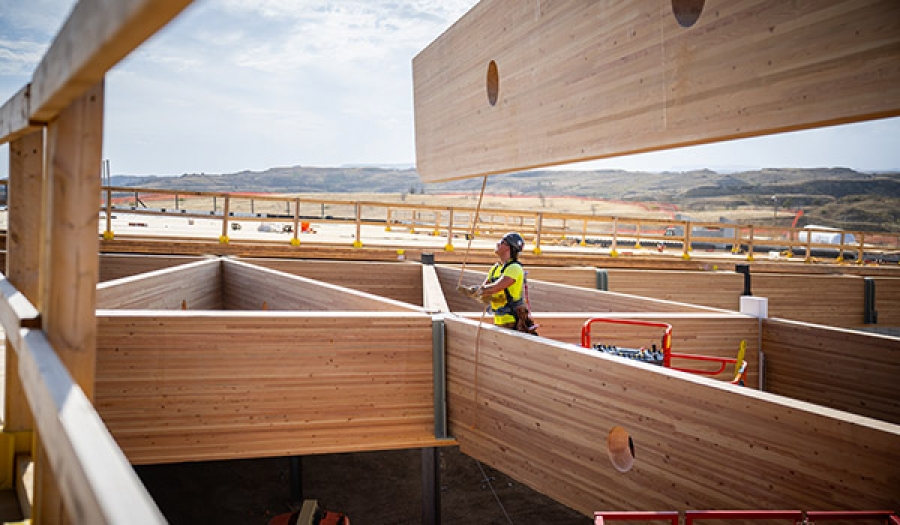
Mass timber elements such as glued laminated timber (Glulam) and cross-laminated timber (CLT) have become increasingly prominent in sustainable construction due to their structural efficiency and reduced environmental impact.
However, fire performance remains a critical consideration for structural safety. This paper presents a comparative assessment of experimentally measured and code-predicted fire performance parameters for Glulam and CLT, including charring rate, effective charring depth, zero-strength layer (ZSL) thickness, and residual mechanical properties.
The evaluation covers major international fire design standards: Eurocode 5 (EC5), the Australian Standard (AS/NZS 1720.4), the Swedish Handbook, American Wood Council (AWC TR10), and the Canadian Standard (CSA O86).
Across all Glulam datasets, charring rate predictions agreed with tests within approximately ±20 percent, while AS/NZS 1720.4 consistently overpredicted charring and effective char depth by around 40 percent.
In contrast, CLT demonstrates greater variability, primarily due to adhesive degradation, delamination, and lamella orientation, which influence heat transfer and post-fire capacity. CLT data exhibited higher scatter, with effective charring depth showing standard deviations of approximately 30–40 percent, ZSL thickness averaging about 2.5 times the typical 7 mm assumption, and residual stiffness commonly reducing to around 20–25 percent of initial values after standard fire exposure.
Overall, findings suggest that current standards adequately address Glulam performance but require refinement to capture the complex fire response of CLT. Continued experimental research and targeted code development, particularly within the Australian Standard, are essential to improve reliability and confidence in performance-based fire design for mass timber structures.
Context
Mass timber represents a transformative advancement in sustainable construction materials, offering a strong and environmentally responsible alternative to conventional materials such as concrete and steel.
It encompasses a family of large, engineered wood products that serve as primary load-bearing components in modern buildings. In mass timber construction, timber functions as the principal structural system supporting floors, walls, and roofs.
Common mass timber products include cross-laminated timber (CLT), glued laminated timber (Glulam), nail-laminated timber (NLT), and dowel-laminated timber (DLT).
Among the most prominent components in this system are CLT and Glulam. Each plays a distinct role in structural design, and together, they enable architects and engineers to create innovative, high-performance buildings.
CLT has emerged as a key innovation in modern timber construction, offering both structural efficiency and environmental benefits. It is produced by layering lumber boards at right angles and bonding them with structural adhesives, creating a material with high dimensional stability and strength.
The timber used in CLT is machine stress-graded and kiln-dried to approximately 12 percent moisture content to ensure uniformity and durability. These panels are generally composed of an odd number of layers, most commonly three, five, or seven, with dimensions that vary according to the manufacturer.
CLT panels can reach lengths of up to 18 m, widths of 5 m, and thicknesses of 500 mm, making them suitable for use in floors, walls, and roof systems.
Structurally, CLT provides a strong and sustainable alternative to conventional materials such as concrete and steel. Crosswise layering provides excellent dimensional stability and allows for the prefabrication of large wall and floor assemblies, which supports efficient installation and enhanced design flexibility.
Glulam is another versatile engineered timber product that is widely used in both architectural and structural applications. Glulam members consist of multiple layers of dimensional lumber, with each layer having the grain oriented parallel to the length of the member.
These laminations are bonded together using durable, moisture-resistant adhesives that produce components with high strength, stiffness, and visual appeal.
Depending on the manufacturer, Glulam members typically range from 180 to 630 mm in thickness, 66 to 200 mm in width, and can be produced in lengths up to 50 m.
This manufacturing flexibility allows Glulam to be produced in large sizes or curved geometries to meet both structural and architectural design requirements.
Glulam exhibits a very high strength-to-weight ratio, which makes it stronger than structural steel when compared by weight, and it is therefore ideal for long span and load-bearing applications.
Contemporary mass timber construction often employs hybrid systems that combine Glulam and CLT to enhance overall structural efficiency. In these configurations, Glulam beams and columns form the primary load-bearing skeleton, while CLT panels function as horizontal diaphragms for floor and roof assemblies.
This integrated approach leverages the high bending and axial strength of Glulam members complemented by CLT's inherent dimensional stability and ease of installation, resulting in a robust and streamlined building system.
Problem Statement
A major challenge associated with timber construction, when compared to conventional materials such as concrete and steel, is its inherent vulnerability to fire, a concern that becomes more critical in tall buildings due to extended evacuation times.
Understanding the fire performance of mass timber structures is essential for ensuring safety and resilience. When timber is subjected to elevated temperatures, it undergoes pyrolysis, a thermal decomposition process that results in the formation of a char layer.
This charring significantly affects the fire resistance of wood components. The char layer develops between the exposed surface and the pyrolysis front, which is commonly associated with the 300 deg C isotherm.
Due to its low thermal conductivity, the char acts as an insulating shield, protecting the underlying uncharred wood from further heat exposure and thereby reducing the rate at which heat penetrates the material.
While extensive research has been conducted on the fire resistance of solid timber and Glulam, CLT presents distinct challenges arising from its layered configuration and adhesive interfaces.
Existing design standards often generalise charring rates and residual strength parameters based on homogeneous materials, without adequately accounting for the effects of delamination, adhesive degradation, and interlaminar heat transfer.
These oversights contribute to discrepancies between experimental observations and code-based predictions. The motivation for this study stems from the need to address these limitations through a detailed comparative investigation of Glulam and CLT fire performance, with the aim of improving the predictive reliability of major international design standards.
From a practical design standpoint, a direct comparison between Glulam and CLT is necessary because their fire response is governed by fundamentally different mechanisms. Glulam behaves largely as a laminated but directionally homogeneous section, for which residual section approaches are commonly applied.
In contrast, CLT has a layered layup and adhesive bond lines that introduce interface phenomena, including heat-induced delamination and char fall-off that can expose fresh wood and alter the progression of damage in ways not captured by assumptions derived from homogeneous or simply laminated members.
This distinction has immediate implications for performance-based fire design. When designers rely on charring-based methods to demonstrate structural adequacy during and after fire, confidence in the underlying assumptions depends on how well those methods represent the dominant physical processes in each product.
For Glulam, simplified methods are often sufficient; for CLT, adhesive behaviour, lamella thickness, and interlaminar heat transfer can govern residual capacity in ways that require careful interpretation of test data and, in many cases, a more explicit modelling of layer interactions.
International Fire Design Codes & Standards
In Europe, the fire design of timber structures is primarily governed by Eurocode 5, EN 1995-1-2, which establishes harmonised methods for evaluating fire resistance, charring behaviour, and load-bearing capacity of solid timber and Glulam elements.
Eurocode 5 specifies two analytical approaches: the Simplified Method (SM), which uses prescribed charring rates and residual section parameters, and the Advanced Calculation Method (ACM), which employs temperature-dependent thermal-mechanical modelling to predict fire-induced behaviour with greater accuracy.
However, Eurocode 5 does not explicitly include provisions for CLT elements, as the material was not yet standardised at the time of publication.
Consequently, CLT fire design in Europe typically relies on national annexes, technical assessments, and supplementary design documents such as the CLT Handbook and research-based guidelines, which extend Eurocode principles to include CLT-specific charring, delamination, and adhesive performance behaviour.
In Australia and New Zealand, the fire design of timber structures is primarily governed by AS/NZS 1720.4, which provides analytical and empirical procedures for determining the fire resistance, charring behaviour, and residual load-bearing capacity of solid timber, Glulam, laminated veneer lumber (LVL), and plywood members.
This standard operates in conjunction with AS 1720.1, which establishes the general structural design principles and load capacity calculations for timber under ambient conditions.
Similar to Eurocode 5, the standard does not explicitly address CLT design, and therefore, CLT fire performance assessment in Australia and New Zealand typically relies on manufacturer data, full-scale fire testing, or supplementary technical publications.
In Sweden, the fire resistance design of timber structures is governed by the Swedish Building Regulations, Boverkets byggregler, used in conjunction with Eurocode 5. Swedish practice extends these European provisions through national guidelines and design aids developed by Swedish Wood.
The Glulam Handbook Volumes 2 and 3 provide detailed guidance on the fire resistance design of Glulam elements, referencing Eurocode 5 for calculating charring rates, residual section geometry, and load-bearing capacity.
Unlike Eurocode 5 and AS/NZS 1720.4, the CLT Handbook published by Swedish Wood provides comprehensive procedures for assessing the fire resistance of CLT elements, accounting for charring behaviour, adhesive performance, and lamella configuration.
The handbook distinguishes between melamine-urea-formaldehyde (MUF) adhesives, which are non-delaminating, and polyurethane (PUR) adhesives, which may delaminate under heat, influencing charring progression.
In the US, the fire design of timber structures is governed by a coordinated framework comprising the International Building Code, the National Design Specification for Wood Construction, and the American Wood Council Technical Report No. 10 (TR10).
Unlike Eurocode 5 and AS/NZS 1720.4, AWC TR10 explicitly includes CLT fire design guidance, accounting for adhesive type, delamination behaviour, and charring rate variations among engineered timber products.
The report advances the modelling of timber behaviour under fire exposure by introducing a nonlinear charring rate approach, which differs from the linear charring assumptions used in other international standards.
For structural analysis, AWC TR10 recommends using an effective char depth to represent the weakened layer adjacent to the char front, defined as 1.2 times the calculated char depth, thereby incorporating a 20 percent allowance for the heated zone with reduced strength and stiffness.
In Canada, the fire design of timber structures is primarily governed by CSA O86, which provides the national framework for the structural design and fire performance evaluation of timber members.
Annex B of CSA O86 provides analytical procedures for determining the charring depth, ZSL, and effective residual cross-section for solid timber, Glulam, and CLT members exposed to standard fire conditions.
The one-dimensional and notional charring rates are prescribed based on the material type and application, aligning closely with the rates adopted in Eurocode 5 but calibrated to reflect Canadian timber properties and manufacturing standards.
To account for the strength reduction in the heated wood beyond the char front, CSA O86 introduces a ZSL that is subtracted from the residual section, with a thickness of 7 mm for exposures of 20 minutes or longer.
Fire Testing & Behaviour
Understanding the fire performance of mass timber elements such as Glulam and CLT is fundamental to ensuring structural safety and advancing the reliability of design standards.
Fire testing provides critical data on charring progression, temperature distribution, delamination behaviour, and residual mechanical performance, enabling validation of theoretical models and regulatory provisions.
This section presents a consolidated review of experimental investigations on Glulam and CLT elements exposed to standard fire conditions.
In this study, a total of six Glulam and CLT element fire experiments were reviewed, providing the experimental foundation for evaluating and comparing the predictive accuracy of international fire design standards.
Darmon and Lalu conducted fire testing of a simply supported Glulam beam subjected to fire on three sides following the ISO 834 standard fire curve.
The test results revealed that the ZSL exceeded the commonly adopted value, suggesting that the Eurocode 5 method may be non-conservative and requires revision.
Fahrni et al. conducted six fire resistance tests at the SP fire laboratory in Stockholm, using a model-scale furnace and four-point bending tests.
The average notional charring rate of six test specimens was found to be 0.73 mm/min, aligning with the 0.7 mm/min rate specified in Eurocode 5.
From four fire tests on Glulam beams under bending stress, an average ZSL thickness of 6.4 mm was identified, aligning with Eurocode 5's 7 mm ZSL thickness.
Navaratnam et al. investigated the fire resistance of glued laminated timber beams to address research gaps related to the limited understanding of loaded beam behaviour, internal temperature distribution, and post-fire stiffness degradation.
The mean charring rates were 0.70 mm/min for non-load bearing beams and 0.71 mm/min for the load-bearing beam. The load-bearing beam retained 22 percent of its initial flexural stiffness after 120 minutes of fire exposure.
The study concluded that GLT beams maintained structural integrity under fire but that AS/NZS provisions were overly conservative.
Lineham et al. conducted experimental tests on CLT beams under four-point bending with simultaneous sustained mechanical loading and intense radiant heating following the ISO 834 standard fire curve.
The results showed that the assumption of a constant 7 mm ZSL thickness is invalid for non-standard heating exposures. The findings highlight the need to replace the ZSL concept with more detailed thermo-mechanical cross-sectional analyses that properly account for the structural effects of real fire exposures.
Xing et al. investigated the fire resistance and ZSL thickness of CLT floor elements to address research gaps regarding ZSL variability, charred layer shedding, and the influence of natural versus standard fire conditions.
The mean charring rate under ISO 834 fire exposure was 0.69 mm/min, slightly higher than the 0.65 mm/min specified by Eurocode 5, whereas under natural fire, the rate exceeded 1.0 mm/min due to faster heating and higher peak temperatures.
The ZSL thickness ranged from 5 to 34 mm, depending on lamella configuration, fire type, and char layer shedding, contrasting with the constant 7 mm assumption in international codes.
Bai et al. investigated the scaling effects on the fire resistance of CLT floors to address gaps in understanding size-dependent charring behaviour, ZSL development, and residual thermo-mechanical performance under standard fire exposure.
Results showed that smaller specimens exhibited faster charring due to reduced thermal inertia, with mean charring rates increasing from 0.63 mm/min for full-scale to 1.10 mm/min for small-scale specimens.
The ZSL thickness ranged between 6 and 25 mm, and loaded specimens retained approximately 20 to 25 percent of their initial stiffness after exposure.
Experimental investigations on Glulam and CLT elements reveal distinct behavioural characteristics under fire exposure. For Glulam, experimental findings generally validate the steady-state charring and residual strength assumptions adopted in international fire design standards.
In contrast, CLT elements exhibit more complex fire behaviour due to cross-laminated layering and adhesive-dependent delamination. Adhesive degradation and delamination remain the dominant contributors to accelerated charring and reduced post-fire stiffness.
The literature review consistently highlights the need for time-dependent and scale-adjusted predictive models that incorporate adhesive thermal resistance, layer separation, and variable ZSL evolution.
Comparative Analysis
A comprehensive evaluation of the charring rates of Glulam and CLT elements under standard fire exposure was conducted, comparing experimental results with predictions from internationally recognised standards.
For Glulam, most international standards produced charring rate predictions relatively close to the measured data, typically within about 10–20 percent. However, the AS/NZS 1720.4 standard consistently predicted higher charring rates than both the experimental results and other standards, indicating a conservative bias of roughly 20 percent on average.
Conversely, Eurocode 5, Swedish, and CSA O86 standards exhibited close agreement, clustered within ±10 percent of tests across datasets.
For CLT elements, all three available standards (Swedish, AWC TR10, and CSA O86) exhibited noticeable discrepancies in charring rates when compared with experimental test data.
Both underestimation and overestimation of charring rates were observed across datasets, indicating that none of the existing standards provided a fully reliable prediction for the charring behaviour of CLT elements.
The observed variation can be attributed to the complex thermo-physical properties of CLT, including adhesive bond line performance, layer orientation, and delamination tendencies.
The effective charring depth represents the combined thickness of the charred layer and the adjacent ZSL, signifying the depth to which timber loses its structural capacity under fire exposure. For Glulam beams, most codes yielded predictions within ±20 percent of the reference data, suggesting reasonable global agreement.
However, AS/NZS 1720.4 consistently produced mean values around 1.4, signifying an overestimation of approximately 40 percent compared with the normalised reference depth.
For CLT elements, the effective charring depth exhibited wider variation than Glulam, with experimental results ranging between 25 mm and 90 mm depending on panel thickness and lamella configuration.
The mean normalised effective charring depth for all standards ranged from 1.3 to 1.4, comparable to those for Glulam. However, the standard deviation for CLT was substantially higher, ranging from 30 percent to 40 percent, nearly double the variability observed for Glulam.
This elevated variability was primarily attributed to CLT's layered construction and the complex interaction between lamella orientation, adhesive degradation, and heat transfer.
The ZSL represents the depth of timber immediately behind the char front that has lost all effective strength due to thermal degradation. For Glulam beams, the mean ZSL thickness averaged approximately 7 mm across codes, demonstrating a relatively stable and predictable response.
The AWC TR10, which defines ZSL thickness as 20 percent of the charring depth, overestimated the mean value by approximately 20 percent and exhibited a standard deviation roughly 40 percent higher than the other codes.
For CLT elements, ZSL thickness varied substantially, ranging from approximately 6 mm to 44 mm. All international codes underpredicted the ZSL thickness when compared to the experimental results.
The mean ZSL derived from the test data was approximately 2.5 times the 7 mm reference value, while the standard deviation exceeded 140 percent, indicating substantial variability. These results confirmed that the constant ZSL assumption, while adequate for Glulam, was not appropriate for CLT design.
For Glulam beams, most standards produced values comparable to experimental data, suggesting that their predictive models provided reasonable estimations of post-fire performance.
However, AS/NZS 1720.4 consistently predicted lower residual strengths than the experimental results, indicating a conservative bias with normalised values typically 30 percent lower than tests. Eurocode 5, Swedish, AWC TR10, and CSA O86 maintained mean values close to unity, demonstrating reliable and balanced performance.
For CLT elements, residual strengths showed extensive scatter ranging from 10 percent to 70 percent depending on lamella configuration, adhesive performance, and degree of delamination. Swedish, AWC TR10, and CSA O86 standards all overestimated the mean residual strength, with mean normalised values ranging from 1.36 to 1.61.
The corresponding standard deviation approached 100 percent for all standards, highlighting the substantial variability of predictions compared with Glulam outcomes.
Residual stiffness predictions for Glulam beams showed considerable scatter when compared with experimental data, indicating inconsistency in predicting post-fire stiffness retention.
AS/NZS 1720.4 consistently underpredicted residual stiffness, while Eurocode 5, Swedish, AWC TR10, and CSA O86 tended to overestimate stiffness recovery.
Standard deviations across all codes ranged between 40 percent and 90 percent, indicating that residual stiffness was more sensitive to localised charring, adhesive degradation, and moisture-induced softening than residual strength.
For CLT elements, residual stiffness ranged from 10 percent to 50 percent of initial stiffness, with greater scatter than Glulam due to composite layer configuration and interlaminar adhesive behaviour.
All standards overestimated stiffness retention, with mean normalised values ranging from 1.46 to 1.65. The standard deviation exceeded 200 percent across all standards, highlighting extreme variability and poor correlation with test data.
The results demonstrate clear and systematically distinct behavioural differences between Glulam and CLT when exposed to fire. Glulam specimens exhibited steady and predictable charring behaviour, consistent with the assumptions embedded in international standards.
Although measured charring rates were marginally lower than design values, the experimentally observed ZSL was often thicker than assumed in most codes. This indicates that while current charring models remain slightly conservative, residual strength predictions may be non-conservative for extended exposure durations.
In contrast, CLT demonstrated a more complex and less predictable thermal response, as evidenced by the increased scatter and bias observed across experimental datasets. Cross-lamination, adhesive softening, and inter-layer interfaces promoted delamination, intermittently exposing previously uncharred layers to renewed heating and accelerating effective charring beyond code-based assumptions.
The adhesive-dependent behaviour provides a critical explanation for the observed divergence between experimental results and code predictions. CLT panels bonded with thermosetting adhesives generally exhibited limited delamination and more stable char development, while panels manufactured with heat-softening adhesives experienced earlier bond degradation, increased delamination frequency, and accelerated charring.
When comparing international standards, Eurocode 5 and CSA O86 provided the closest agreement with experimental charring rates for Glulam, whereas AWC TR10 and AS/NZS 1720.4 were consistently more conservative.
For CLT, however, none of the evaluated standards adequately captured the magnitude or variability of the observed charring behaviour, reinforcing the need for time-dependent, adhesive-sensitive, or interface-aware correction factors.
Findings
Based on the comparative analyses and discussions presented, this study provides a comprehensive evaluation of the fire performance of Glulam and CLT structural elements benchmarked against international design standards.
The results demonstrate that Glulam generally exhibits consistent and predictable behaviour, while CLT displays greater variability due to its layered composition and adhesive sensitivity under fire exposure.
Most international standards predicted Glulam charring rates within ±20 percent of experimental data. AS/NZS 1720.4 consistently overpredicted charring rates and effective charring depths by approximately 40 percent, resulting in conservative yet less accurate outcomes.
CLT exhibited higher variability in effective charring depth, with standard deviations between 30 percent and 40 percent, primarily due to adhesive degradation and delamination.
For Glulam, all considered design codes predicted charring rates within ±20 percent for timber densities greater than 450 kg/m³, with the lowest standard deviations.
For timber densities below 450 kg/m³, charring rate predictions were within ±8 percent except for AS/NZS 1720.4. CLT charring rate predictions were within ±20 percent across all densities, but scatter was higher, with standard deviations of up to 35 percent.
For CLT panels, all codes overpredicted charring rates for MUF adhesives, with the largest overprediction around 40 percent for AWC TR10 and standard deviations below 10 percent, while 1C-PUR adhesives were underpredicted by about 20 percent, with higher variability.
Under standard fire, all codes overpredicted CLT charring rates, with a maximum of 20 percent for AWC TR10 and standard deviations around 30 percent.
Under natural fire, charring rates were underpredicted by 40 percent, with variability of 10 percent. The ZSL for Glulam was accurately captured by fixed value models, while CLT displayed significantly larger and more variable ZSLs due to interlaminar failure and adhesive degradation.
Glulam residual strength predictions were reliable across all standards except AS/NZS 1720.4, which underestimated residual strength by 20 percent to 30 percent.
CLT residual strength exhibited high scatter, with standard deviations exceeding 50 percent, caused by non-uniform charring and interlaminar shear loss.
Residual stiffness predictions for both Glulam and CLT were inconsistent across all standards, generally overestimating stiffness recovery. CLT results exhibited variability approaching 100 percent, driven by delamination and adhesive softening.
In conclusion, the current suite of international design standards remains adequate for Glulam but insufficient for accurately predicting CLT fire performance.
This study highlights the need for continued experimental research and refinement of design models, particularly within the Australian context where specific CLT fire provisions are currently lacking.
Incorporating adhesive performance, lamella configuration, and delamination mechanisms into future standards will be essential to improve predictive reliability and support the development of safe, efficient, and performance-based fire design for mass timber structures.
By directly comparing Glulam and CLT within a unified analytical framework, this review clarifies where current design standards are dependable and where they are not.
Practically, the results support confident use of simplified methods for Glulam, while recommending adhesive-sensitive, time-dependent models for CLT to account for delamination and char loss.
For regulators, the outcomes provide evidence-based priorities for near-term updates, particularly in AS/NZS 1720.4, to incorporate adhesive qualification, lamella configuration, and ZSL evolution.
For practice, the review underpins risk-consistent performance-based fire design, encouraging targeted testing and advanced analyses where CLT is left exposed. These steps will help realise the safety, sustainability, and constructability benefits of mass timber at scale.
