


Page 60 - FDMAsia MarApr 2025
P. 60
58   MATERIALS                                                                    MAR/APR 2025 FDM ASIA | www.fdmasia.com


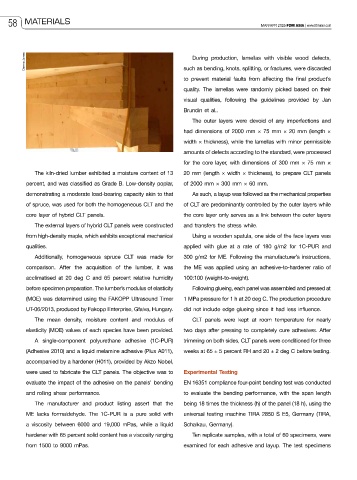
         Denna Jones                                         such as bending, knots, splitting, or fractures, were discarded
                                                                During production, lamellas with visible wood defects,

                                                             to prevent material faults from affecting the final product’s
                                                             quality. The lamellas were randomly picked based on their

                                                             visual  qualities,  following  the  guidelines  provided by  Jan
                                                             Brundin et al..
                                                                The outer layers were devoid of any imperfections and
                                                             had dimensions of 2000 mm × 75 mm × 20 mm (length ×
                                                             width × thickness), while the lamellas with minor permissible
                                                             amounts of defects according to the standard, were processed
                                                             for the core layer, with dimensions of 300 mm × 75 mm ×
            The kiln-dried lumber exhibited a moisture content of 13   20 mm (length × width × thickness), to prepare CLT panels
          percent, and was classified as Grade B. Low-density poplar,   of 2000 mm × 300 mm × 60 mm.

          demonstrating a moderate load-bearing capacity akin to that   As such, a layup was followed as the mechanical properties
          of spruce, was used for both the homogeneous CLT and the   of CLT are predominantly controlled by the outer layers while
          core layer of hybrid CLT panels.                   the core layer only serves as a link between the outer layers
            The external layers of hybrid CLT panels were constructed   and transfers the stress while.
          from high-density maple, which exhibits exceptional mechanical   Using a wooden spatula, one side of the face layers was
          qualities.                                         applied with glue at a rate of 180 g/m2 for 1C-PUR and
            Additionally, homogeneous spruce CLT was made for   300 g/m2 for ME. Following the manufacturer’s instructions,

          comparison.  After  the  acquisition  of  the  lumber,  it  was   the ME was applied using an adhesive-to-hardener ratio of
          acclimatised at 20 deg C and 65 percent relative humidity   100:100 (weight-to-weight).
          before specimen preparation. The lumber’s modulus of elasticity   Following glueing, each panel was assembled and pressed at
          (MOE) was determined using the FAKOPP Ultrasound Timer   1 MPa pressure for 1 h at 20 deg C. The production procedure
          UT-06/2013, produced by Fakopp Enterprise, Gfalva, Hungary.   did not include edge glueing since it had less influence.
            The  mean  density,  moisture  content  and  modulus  of   CLT panels were kept at room temperature for nearly
          elasticity (MOE) values of each species have been provided.  two days after pressing to completely cure adhesives. After
            A single-component polyurethane adhesive (1C-PUR)   trimming on both sides, CLT panels were conditioned for three
          (Adhesive 2010) and a liquid melamine adhesive (Plus A011),   weeks at 65 ± 5 percent RH and 20 ± 2 deg C before testing.

          accompanied by a hardener (H011), provided by Akzo Nobel,
          were used to fabricate the CLT panels. The objective was to   Experimental Testing
          evaluate the impact of the adhesive on the panels’ bending   EN 16351 compliance four-point bending test was conducted
          and rolling shear performance.                     to evaluate the bending performance, with the span length
            The manufacturer and product listing assert that the   being 18 times the thickness (h) of the panel (18 h), using the
          ME lacks formaldehyde. The 1C-PUR is a pure solid with   universal testing machine TIRA 2850 S E5, Germany (TIRA,
          a viscosity between 6000 and 19,000 mPas, while a liquid   Schalkau, Germany).

          hardener with 65 percent solid content has a viscosity ranging   Ten replicate samples, with a total of 60 specimens, were
          from 1500 to 9000 mPas.                            examined for each adhesive and layup. The test specimens

