


Page 54 - FDMAsia JulAug 2025
P. 54
52   MATERIALS                                                                    JUL/AUG 2025 FDM ASIA | www.fdmasia.com


          panels, which are structurally adapted for embedding smart   Table 5. The strategic implications for industry and
                                                             innovation.
          functionalities like sensors or power units.        Strategic Dimension  Implication
            Once integrated, these assemblies are subjected to TQM-  Materials Strategy  Replacing virgin wood or synthetic
          based quality validation, including environmental stress tests         plastics with pellet-derived WPCs
                                                                                 supports circular economy goals and
          and functional performance audits.                                     carbon footprint reduction.
            In parallel, user feedback—gathered via post-deployment   Design Innovation  Modular smart systems allow
                                                                                 for adaptive living environments,
          monitoring or modular usage analytics—is incorporated into             reduced waste, and future-proof
                                                                                 product designs.
          a feedback loop that informs iterative design and process
                                                              Operational Excellence  Implementing TQM aligns
          improvement.                                                           sustainability goals with efficiency,
                                                                                 supporting zero-defect production
            This closed-loop structure supports the creation of adaptive,        and material traceability.
          durable, and user-responsive smart furniture, aligned with the   Market Differentiation  Products certified under FSC,
                                                                                 GREENGUARD, and C2C
          principles of circular economy and continuous innovation.              schemes command greater trust
                                                                                 among environmentally conscious
            The process begins with WPC material selection, ensuring             consumers.
          that environmentally friendly materials with strong mechanical
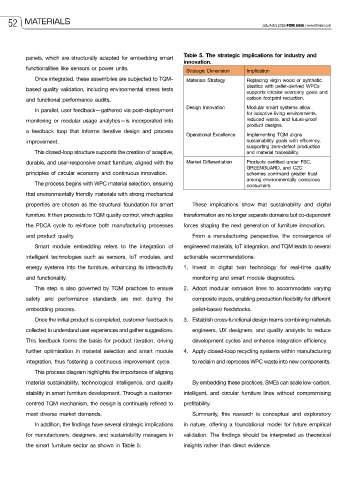
          properties are chosen as the structural foundation for smart   These implications show that sustainability and digital
          furniture. It then proceeds to TQM quality control, which applies   transformation are no longer separate domains but co-dependent
          the PDCA cycle to reinforce both manufacturing processes   forces shaping the next generation of furniture innovation.
          and product quality.                                  From a manufacturing perspective, the convergence of
            Smart  module  embedding  refers  to  the  integration  of   engineered materials, IoT integration, and TQM leads to several
          intelligent technologies such as sensors, IoT modules, and   actionable recommendations:

          energy systems into the furniture, enhancing its interactivity   1.  Invest in digital twin technology for real-time quality
          and functionality.                                    monitoring and smart module diagnostics.
            This step is also governed by TQM practices to ensure   2.  Adopt modular extrusion lines to accommodate varying
          safety and performance standards are met during the   composite inputs, enabling production flexibility for different
          embedding process.                                    pellet-based feedstocks.
            Once the initial product is completed, customer feedback is   3.  Establish cross-functional design teams combining materials
          collected to understand user experiences and gather suggestions.   engineers, UX designers, and quality analysts to reduce
          This feedback forms the basis for product iteration, driving   development cycles and enhance integration efficiency.
          further optimisation in material selection and smart module   4.  Apply closed-loop recycling systems within manufacturing

          integration, thus fostering a continuous improvement cycle.  to reclaim and reprocess WPC waste into new components.
            This process diagram highlights the importance of aligning
          material  sustainability,  technological  intelligence,  and  quality   By embedding these practices, SMEs can scale low-carbon,
          stability in smart furniture development. Through a customer-  intelligent, and circular furniture lines without compromising
          centred TQM mechanism, the design is continually refined to   profitability.
          meet diverse market demands.                          Summarily, this research is conceptual and exploratory
            In addition, the findings have several strategic implications   in nature, offering a foundational model for future empirical

          for manufacturers, designers, and sustainability managers in   validation. The findings should be interpreted as theoretical
          the smart furniture sector as shown in Table 5:    insights rather than direct evidence.

