

Mr. John Chan, Regional Director of American Hardwood Export Council (AHEC) Southeast Asia & Greater China
FDM: Could you first provide a detailed overview of American hardwood exports to the Chinese market throughout 2024? What notable changes or trends were observed compared to 2023? Additionally, since the beginning of 2025, how has the export situation of American hardwood to China evolved?
Mr. John Chan: In 2024, the total value of American hardwood exports to the Greater China market reached US$1.35 billion, marking a nearly 15 percent increase compared to 2023. During the first two months of 2025 alone, exports approached US$200 million.
Despite this strong performance, the outlook for American hardwood exports to China remains uncertain due to several external factors, including the global economic slowdown, ongoing challenges in the Chinese real estate sector, and lingering tariff concerns.
However, it's important to note that American hardwood continues to play a significant role in the Chinese market—approximately 85 percent of imported American hardwood in China is utilised in domestic furniture manufacturing, interior decoration, and construction projects across residential, commercial, office, and hospitality sectors.
Furthermore, with early signs of stabilisation in China’s real estate market and a projected recovery in domestic consumption, the long-term demand for high-quality hardwood is expected to grow.
China remains the largest export market for American hardwood, and given these developments, we remain cautiously optimistic about the future export prospects.
FDM: Recently, AHEC participated in the 40th Shenzhen Creative Week and the interzum guangzhou 2025 exhibition. What positive outcomes have these events had in promoting American hardwood in the Chinese market? Are there plans for AHEC to carry out similar promotional activities in China throughout the rest of the year?
Mr. John Chan: The China Shenzhen Creative Week & the 40th Shenzhen International Furniture Expo was held from March 16–19, 2025, at the Shenzhen Exhibition & Convention Center. Recognised as one of China’s most influential platforms for creativity and innovation, Shenzhen Creative Week has established itself as a leading event in the furniture and interior design industry.
For AHEC, this event offered an exceptional opportunity to showcase the sustainability and design potential of American hardwoods to a broader audience.
By participating in both Shenzhen Creative Week and interzum guangzhou 2025, AHEC was able to engage directly with a wide range of industry professionals, including designers, architects, and manufacturers.
These events allowed us to promote the environmental benefits of American hardwoods and emphasise the unique aesthetics and versatility of US hardwood species in design.
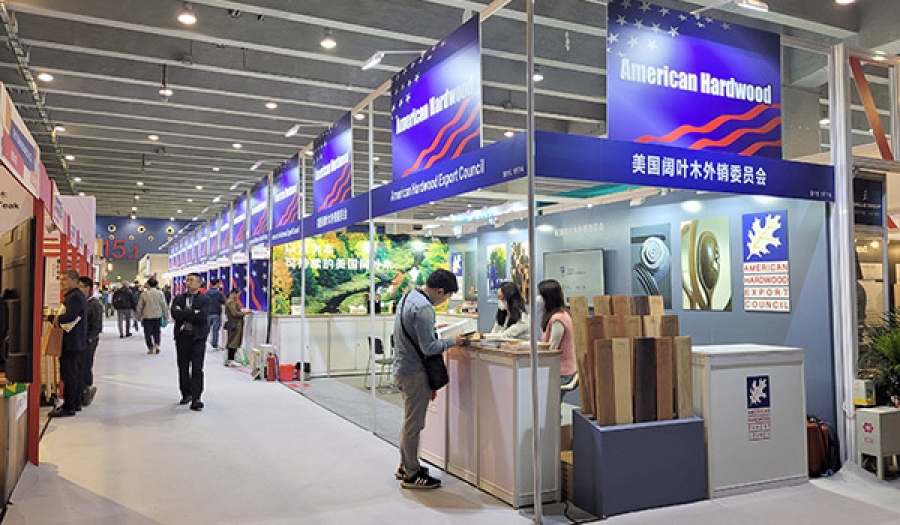
At AHEC’s 150-square-meter booth—our debut presence at Shenzhen Creative Week—we introduced our sustainable hardwoods through an immersive experience that demonstrated their application across furniture, bedrooms, kitchens, living rooms, and flooring.
We focused on conveying the value of natural materials in addressing climate change and supporting sustainable design. Increasingly, designers are seeking green-certified materials, and these events enabled us to communicate how American hardwoods—sourced from responsibly managed forests—can meet those standards while inspiring creative, high-quality designs.
The exhibitions also provided a valuable platform for dialogue with long-time partners and new contacts. We had meaningful exchanges with interior designers, architects, and other stakeholders about expanding the use of American hardwoods in environmental design, architecture, and premium furniture manufacturing.
Despite current global challenges—such as economic uncertainty, real estate fluctuations, and shifting trade dynamics—China’s furniture and interior design industries continue to advance rapidly, especially in the direction of high-end, eco-conscious development.
This progress has not only shaped domestic trends but also had a growing impact across the ASEAN region. With its unique combination of sustainability, beauty, and versatility, American hardwood is well-positioned to meet the evolving needs of these markets.
We view Shenzhen Creative Week, alongside the International Furniture Expo, as a valuable platform for fostering global trade cooperation and business growth. Encouraged by this year's positive outcomes, AHEC is considering returning to exhibit next year.
In addition, AHEC will host a series of seminars in 2025, bringing together not only architects and interior designers but also timber importers and furniture manufacturers.
These events will focus on exploring the design possibilities and practical applications of American hardwoods, aiming to deepen market understanding and foster collaboration across the value chain.
Ms. Zhang, Marketing Executive of Malaysian Timber Council
FDM: Malaysia is known for its rich diversity of timber species. Could you share which species the Malaysian Timber Council (MTC) is currently focusing on promoting to the market? Additionally, what types of timber products will MTC primarily showcase at the interzum guangzhou 2025 exhibition? What are the key advantages of timber and timber products originating from Malaysia?
Ms. Zhang: Currently, are are actively promoting several key timber species to the market, including Meranti, Rubberwood, Keruing (KSK), Merpauh, and Sepetir. Malaysia exports a wide range of wood products to global markets, including sawn timber, panel products, and furniture.
At interzum guangzhou 2025, our primary focus is on showcasing furniture materials and components to both domestic and international buyers. Malaysian companies are also well-equipped to supply semi-finished or fully finished products tailored to meet the specific needs of buyers.
Malaysia benefits from an abundance of high-quality tropical hardwoods sourced from its extensive rainforests. These hardwoods are known for their durability and excellent natural resistance to decay, making them ideal for use in furniture, construction, and outdoor products.
The country's timber processing industry is also highly developed, with well-established procedures for kiln drying and product finishing, ensuring consistent quality and reliability in exports.
Moreover, Malaysia places a strong emphasis on the sustainable management of its forest resources. Through the implementation of various environmental policies and responsible forestry practices, the country ensures the long-term sustainability of its timber industry while maintaining its commitment to environmental stewardship.
FDM: We understand that Malaysia has set a number of forward-looking environmental development goals aimed at promoting the sustainable growth of its timber industry and addressing the challenges posed by climate change. In this context, what positive role has MTC played so far? Looking ahead, what specific measures will MTC implement to further advance sustainable forest management and contribute to climate change mitigation?
Ms. Zhang: First and foremost, in terms of ensuring the legality of timber sources, MTC has consistently promoted the Malaysian Timber Certification Scheme (MTCS) to guarantee that all timber originates from sustainably managed forests.
We have long advocated for the use of timber as a renewable, low-carbon material that plays a vital role in carbon sequestration and reducing greenhouse gas emissions. In addition, MTC actively participates in international efforts to combat climate change and support sustainable forest management.
Looking ahead, MTC will continue to promote Malaysia’s sustainably produced timber products on the global stage through trade exhibitions, market visits, and other outreach initiatives.
At the same time, we will support the local timber processing industry in upgrading its equipment and adopting innovative technologies to enhance wood utilisation and minimise waste.
We are also committed to providing industry stakeholders with timely information and resources to help them stay informed on the latest developments, trends, and best practices in sustainability and climate resilience.
FDM: What are the current main export markets for Malaysian timber, and does MTC have plans to support the industry in exploring emerging markets and expanding its trade partnerships in the future?
Ms. Zhang: Currently, Malaysia’s timber and timber products are primarily exported to markets in the US, Europe, the Middle East, and Asia.
MTC remains dedicated to supporting the growth of the local timber industry. Moving forward, MTC plans to actively promote Malaysia’s timber trade by participating in international trade fairs, organising overseas market inspections, and arranging business matching events.
Additionally, MTC will continue hosting the Malaysian Wood Expo, inviting global timber buyers to Malaysia to deepen their understanding of Malaysian timber and timber products. This initiative not only offers a diversified procurement platform but also creates more opportunities for trade cooperation, benefiting local businesses across the country.
Mr. Noah Li, Director from Quebec Wood Export Bureau (QWEB), China
FDM: Could you please start by briefly introducing the Quebec Wood Export Bureau (QWEB)? We would also like to know what positive contributions QWEB has made to the development of China’s wood products and wood structure industries. Additionally, given that wood structures are now widely used in areas such as residential buildings, cultural venues, and landscape architecture, could you explain their main advantages?
Mr. Noah Li: I’d like to begin by introducing the Quebec Wood Export Bureau (QWEB).
Established in 1992, QWEB is a global non-profit organisation jointly funded by the Canadian federal government, the Quebec provincial government, and Natural Resources Canada.
Our mission is to promote hardwood and softwood products from Quebec, Canada, along with advanced modern wood structure building technologies and products, to support the rapid development of China’s wood products and wood structure industries.
QWEB operates across five sectors: hardwood, softwood, hardwood flooring, wood pellets, and wood structures. The hardwood and softwood sectors include materials such as red oak, white oak, and SPF (spruce-pine-fir, abundant in Canada’s cork forests), which are widely used in furniture manufacturing, building materials, and packaging.
Our hardwood flooring and wood pellet products are also highly favoured in European and North American markets.
Since entering the Chinese market in 2004, QWEB has actively promoted wood structures. Globally, wood structures are categorised mainly into light-frame wood structures and mass timber structures. In Canada, nearly 90 percent of residential homes are built using light-frame wood structures.
In China, we primarily collaborate on light-frame wood structure projects with resorts and tourist attractions. Mass timber structures, on the other hand, are used for large-scale buildings such as stadiums, hospitals, nursing homes, and government offices.
A key innovation in this field is Cross Laminated Timber (CLT) technology, which enables rapid construction of residences while significantly reducing carbon dioxide emissions. Globally, very few enterprises offer complete CLT technology, but Quebec is home to two such providers.
One of the greatest advantages of wood structures is their carbon sequestration ability, which contributes significantly to energy conservation and emission reduction.
For example, replacing one cubic centimetre of reinforced concrete with wood can reduce carbon dioxide emissions by 270 cubic centimetres.
Fire resistance, often a concern with wood buildings, is another strength: tests show that wood structures can withstand fire without collapsing for over two hours, allowing ample time for evacuation, whereas reinforced concrete buildings may fail within 30 minutes at temperatures above 200 deg C.
Wood structures also outperform reinforced concrete in seismic resilience. Beyond functionality, mass timber structures are valued for their aesthetic appeal and environmental friendliness, making them popular choices for stadium domes and other large-scale architectural projects.
Mr. Lee Wang, Sales Manager of Pollmeier Massivholz
FDM: Pollmeier is Europe’s largest hardwood producer and the market leader in beech lumber. Could you please introduce the key characteristics and competitive advantages of the hardwood and beech lumber products promoted by Pollmeier? Additionally, what core philosophy or concept does Pollmeier follow in its operations?
Mr. Lee Wang: Pollmeier, headquartered in Germany, is a leading European producer specialising in beech lumber and components, with a strong focus on helping customers reduce material costs.
Hardwood is renowned as an excellent material for furniture and various wood products, but cost efficiency has become increasingly critical in production.
Recognising this, we align with industry standards in planning, cost calculation, and warehousing to offer sustainable, high-quality hardwood at competitive prices through its component lumber solutions. Numerous customer case studies have demonstrated that component lumber is one of the most cost-effective options available.
One of the key advantages of using dimension lumber from Pollmeier lies in its ease of processing. It eliminates the need for surface sanding; a simple table saw can round the edges and lightly sand the surface, saving time, reducing processing steps, and minimising material waste.
Using component lumber can reduce waste by up to 40 percent, lower material costs by 15 percent to 35 percent, and decrease the workload for cross-cutting and longitudinal cutting. This also translates into lower costs for waste disposal, transportation, import, and warehousing.
Pollmeier’s beech lumber is characterised by its square-edged, lightly steamed boards that exhibit a light, uniform colour. The wood is precisely kiln-dried to a moisture content of 7-9 percent, then carefully conditioned to ensure stability across different environmental conditions.
Both sides of the lumber are pre-sanded, providing a smooth surface from the outset. The lumber is quality-sorted according to the stringent standards of the National Hardwood Lumber Association (NHLA), guaranteeing customers receive consistently high-quality material.
Additionally, the closed-pore structure of our beech makes it especially suitable for staining and ensures excellent surface quality.
Other notable features of our components include precise dimensions, stable quality, and short lead times. Importantly, all timber is sourced from sustainably managed forests, reflecting our commitment to environmental responsibility and ensuring the long-term availability of this premium hardwood.
