

Lockdown Measures and the State of Malaysian Economy
Malaysia’s response strategy against COVID-19 centred on its 6R recovery plan – Resolve, Resilience, Restart, Recovery, Revitalise and Reform – where lockdown measures fell within the “Resolve” stage which involved the Movement Control Order (MCO), Conditional Movement Control Order (CMCO) and Recovery Movement Control Order (RMCO) which has been extended to 31 December 2020.
MCO consisted of four phases and served as the basis of the latter two types of movement control orders. The restrictions covered, among others, the general prohibition of social activities and gatherings. Travellers were restricted from going to Malaysia, while outbound travels by Malaysians were also restricted and returning citizens were subjected to a 14-day quarantine. Schools and other government and private premises were closed with the exception of a number of “essential” sectors and services with many operating at half capacity with strict adherence to health and hygiene standard operating procedures (SOPs) set by the Ministry of Health (MOH).
The imposition of CMCO relaxed most of the restrictions enforced during the MCO as most economic sectors were allowed to operate. Businesses were required to enforce social distancing policy at their premises and set up a contact tracing measure by recording the details of their customers and/or workers. Most social activities were still restricted except for non-contact sports and small gathering of not more than 10 persons. Interstate travels were also restricted to avoid cross-infection among high-risk and low-risk states.
The current stage of MCO is the RMCO – the fourth stage of the 6R recovery plan – where it is geared towards reviving the economy for the short-term once the infection rate of COVID-19 is under control. Under the RMCO, almost all economic and social activities, including interstate travels are allowed while observing the usual new normal SOPs. However, mass gathering and activities with mass audience are still banned.
Malaysia was also affected by the disrupted global supply chains due to lockdown measures imposed at different timings by its major trading partners which act as important logistical and import-export hubs such as Singapore and China. Businesses in the country were reportedly losing as much as RM2.4 billion (USD550 million) every day when Malaysia imposed the MCO from 18 March to 3 May 2020.
The impact of MCO could be seen from the report by IHS Markit Malaysia Manufacturing Purchasing Managers' Index (PMI) standing at 45.6 in May compared to 31.3 in April, 48.4 in March, 48.5 in February and 48.8 in January 2020 as concerns on the lockdown situation in China and deteriorating global trade and consumer confidence picked up. The situation improved in June and July 2020, however, with the index showing an expansionary trend by sitting at 51.0 and 50.0 levels, respectively, as the economy reopened during CMCO and further restriction relaxation during RMCO. A number further below 50.0 in the PMI denotes a more severe contraction in manufacturing activity.
The recently released trade figures up to July 2020 matched analysts expectation with Malaysia’s exports declining 6.8% year-on-year to RM541.5 billion (USD127 billion) and imports falling by 7.4% year-on-year to RM451.8 billion (USD105.9 billion). Exports of timber products also suffered, decreasing by 9.1% to RM9.6 billion (USD2.2 billion) while, in contrast, imports exponentially increased by 13% to RM3 billion (USD702 million) in the first six months of 2020.
In addition, the unexpected oil price crisis stemming from the dispute within the Organization of the Petroleum Exporting Countries (OPEC) and Russia had caused oil prices to tank and the Ringgit to depreciate from RM4.09 per US dollar on 31 December 2019 to as low as RM4.44 per US dollar on 23 March 2020 before recovering to RM4.15 per US dollar on 2 September 2020. Taking these and other headwind factors at the global landscape into account, the World Bank, in its June 2020 Global Economic Prospects, has estimated Malaysia’s economy to shrink by 3.1% in 2020.
Government and Private Initiatives
The government of Malaysia recognised the threat of COVID-19 to the economy and its people, starting from the first positive cases back in January 2020 and had taken measures to support businesses and salaried persons to temporarily insulate them from the abrupt negative impacts of the pandemic and MCO.
The over RM260 billion (USD59.6 billion) PRIHATIN stimulus package was rolled out for three reasons: to protect the people, to support businesses and strengthen the economy. Of this amount, RM110 billion (USD25.2 billion) was allocated to support businesses. The stimulus package was worth 17% of the country’s GDP, compared to RM67 billion (USD15.2 billion) or 8% of GDP rolled out during the 2009 Global Financial Crisis.
Among the programmes and incentives provided by the government for businesses under the PRIHATIN Stimulus Package were deferment/exemption of statutory contributions, tax, and levy; reduction of operating cost; and financing facilities/relief, among others.
The Malaysian government also injected further assistance to businesses through the PENJANA Short-Term Economic Recovery Plan worth RM35 billion (USD8 billion) on the verge of entering the “Recovery” stage of the 6R Recovery Plan. The plan, partly supplementing the PRIHATIN package, also expands the coverage of the earlier stimulus plans for the benefit of micro businesses and SMEs.
In August, the government supplemented towards the COVID-19 recovery fund through the issuance of Sukuk Prihatin worth RM500 million (USD117.2 million) with a profit rate of 2%. The proceeds from this programme will contribute, among others, towards financing micro SMEs, particularly women entrepreneurs.
Timber Industry
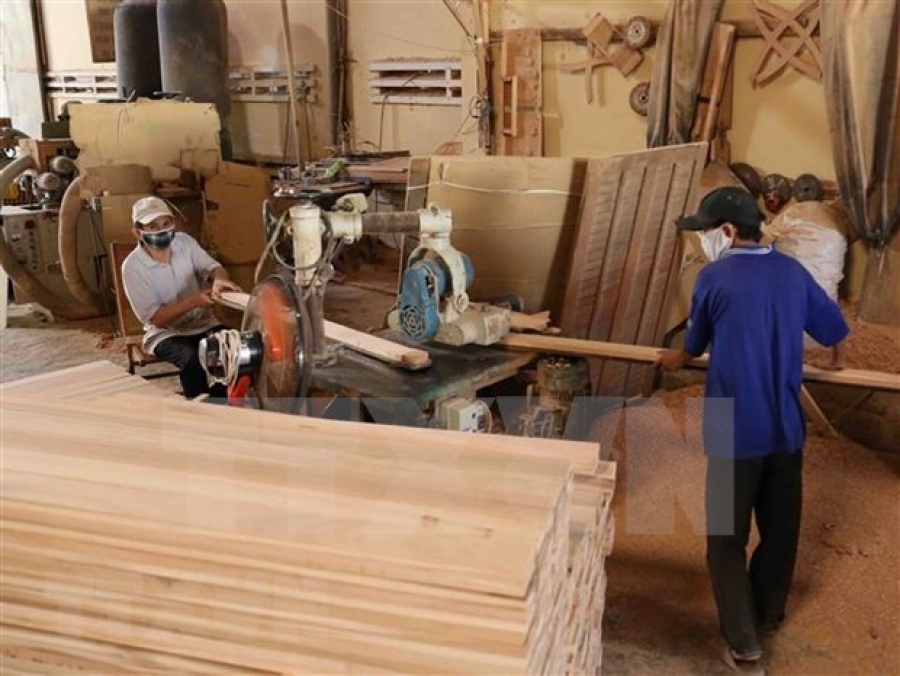
The commodities sector including the timber industry in Malaysia, under the Ministry of Plantation Industries and Commodities (MPIC), received a special approval from MOH to continue operating during MCO. As of 4 May 2020, more than 30% of the timber-based manufacturers and processors had received the approvals to operate.
The Malaysian Timber Council (MTC) played an active role in getting, analysing, and channelling feedback from the industry on issues related to the MCO to the relevant ministries and agencies for further action in facilitating the smooth operation of the timber industry. The Council also worked closely with the Ministry of International Trade and Industry (MITI) and the Malaysian Timber Industry Board which helped evaluate and approve the companies to operate during the MCO.
MTC had also conducted an industry-wide survey on the impact of MCO on the Malaysian timber industry in April 2020. Majority of the respondents were small and medium enterprises (SMEs) employing between five to 75 employees and earning between RM300,000 to RM3 million annually.
The respondents ranked the issue of loss of income as the top impact of COVID-19 and the MCO. This was followed by financial challenges, unable to fulfil existing orders, difficulty in obtaining raw material/components, postponement of orders and staffing problems.
Manufacturers also cited the availability of raw materials and input components as problems. Most of the companies employed cost-saving measures which included changing their business models, downsizing, diversifying their business into other sectors or increasing their product range, diversifying sources of raw material and components as well as embarking on digital transformation.
MTC conducted another survey from 1 to 2 June 2020 where 90% of the companies surveyed had resumed operations whereas 60% respondents replied that they were operating at more than 70% capacity after the implementation of the CMCO. The survey also found that 63% of the respondents had resumed export activities with the US, Japan and Australia being the top three destinations.
Several consultation sessions on managing the impact of the COVID-19 pandemic were also held with major timber associations and key industry players. Among the concerns highlighted were the slowing global and domestic demand, cashflow management, order fulfilling issues, sustaining workforce, and losing business to competitors.
The survey findings and consultation discussions have been crucial towards MTC making a drastic change to its operation model and revising its activities for 2020 to help the timber industry build resilience during this crisis and sustain businesses. MTC has recalibrated its budget to focus on initiatives that will increase the timber industry’s productivity and capabilities as well as to leverage on digital platforms and channels for more effective promotional and communication programmes.
Way Forward
The global economic landscape will remain challenging until a reliable vaccine to COVID-19 is found and mass produced. The timber industry in Malaysia will also experience the downturn cycle. However, with the right corrective measures in place, businesses can remain viable. The government of Malaysia has signalled of more assistance to stimulate the economy and businesses to weather the storm once it has assessed the impact of the PRIHATIN Stimulus Package and PENJANA Short-Term Economic Recovery Plan.
MTC, too, in line with the aspiration of the country, will continue to take necessary measures in view of the challenges faced by the timber industry, to sustain its business and emerge more resilient after the crisis.
