

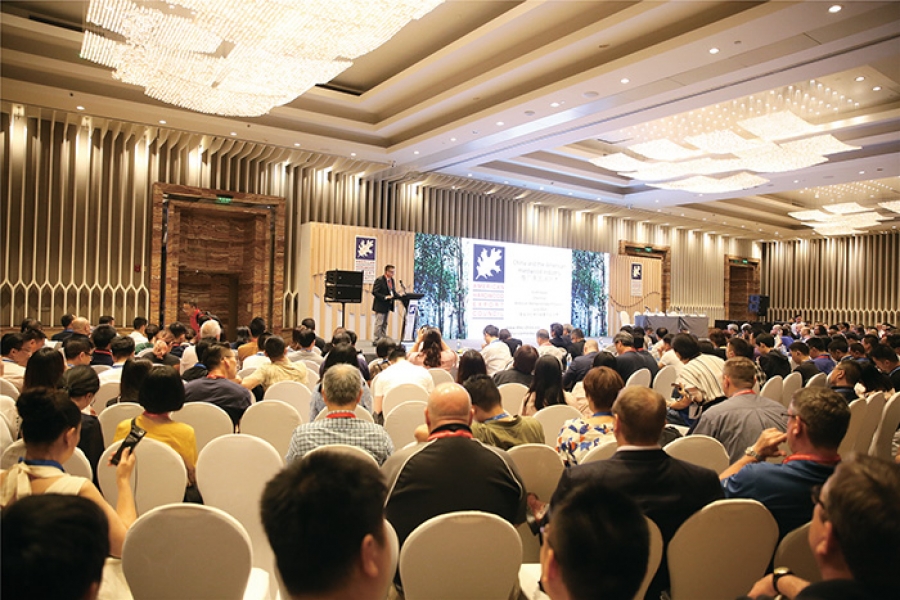
This year, AHEC continued its promotion for the sustainability of American hardwood with the theme of ‘Living Beauty with Sustainable American Hardwood’.
The convention is co-organised by Ningbo Furniture Chamber of Commerce and received the support of over 30 industry associations and media from Greater China and Southeast Asia.
The event attracted architects, interior designers, timber contractors, traders, importers, wholesalers across Greater China and Southeast Asia and 48 AHEC member companies to explore the sustainable development of American hardwood, the future of low-carbon, new technology, timber grading rules, and further promote application of American hardwood in architecture and interior design.
Many industry authorities were invited to speak at the convention, including: Bobby Richey, Agricultural Minister-Counselor, Embassy of the US Agricultural Affairs Office; Michael Snow, Executive Director of AHEC; Scott Seyler, Chairman of AHEC; John Chan, Regional Director of AHEC SEA & Greater China; Dr. Scott Bowe, Professor of Wood Products from College of Agricultural and Life Science of University of Wisconsin-Madison; Judd Johnson, Managing Editor of the Hardwood Market Report; Silas Chow, Director of SOM China and President of AIA Shanghai | Beijing; Patrick Fong, Director of PFD Hong Kong and Hangzhou and Founding Chairman of Hong Kong Interior Designers Association (HKIDA); Dana Spessert, Chief Inspector and Dean of Education of Grading School of National Hardwood Lumber Association and Ding Min, President of Ningbo Furniture Chamber of Commerce.
The speakers shared insights on the American hardwood market in China, the advantages of American hardwood for sustainable development and immense potential of American hardwood in architecture and interior design.
Benefits of American Hardwood
For his speech, Mr. Snow explained the benefits that American hardwood has on the environment and analysed how to meet sustainable development goals like carbon sequestration and emission reduction through scientific management and widespread use of American hardwood.
He introduced, “Wood is widely recognized by the industry as a material that has a positive impact on the environment. American hardwood has a particularly high level of sustainability with treatment recognized by sustainable forest certifications. Apart from the inherent sustainability of forests, the creation of American hardwood furniture or other products also produces minimal carbon that is well aligned with environmental goals.”
Commenting on the export situation of American hardwood, Mr. Snow said, “From January to April 2019, American hardwood lumber exports to Southeast Asia markets surged 19.3 percent year-on-year, to US$131 million.
American Hardwood Exports
On the other hand, American hardwood exports to the Greater China faces many challenges due to the trade war, tariffs, extreme weather and a general slowing of demand, but China remains the largest export market for American hardwood.
American hardwood lumber exports totalled US$484 million in Greater China for January to April 2019, a decline from the previous year.
Looking forward to the second half of this year and towards the future, we hope that market conditions will recover as soon as possible.
At the same time, we will continue to put more effort into collaborations and promotions in the Greater China market, discover more market needs, fully utilise the low-carbon characteristics of American hardwood and promote American hardwood application in more fields.
“In the 28 years that we have been in the China market, we have always promoted the sustainability of American hardwood and believed in the potential to develop it into a unique and innovative brand,” said Mr. Chan. “Every year, we invite well-known designers and architects to share their thoughts on sustainability and their experience of using American hardwood.”
“Working with many designers, we discovered that ‘Green’ has become the latest trend in design. In some classic design cases, designers would all seemingly choose American hardwood for the main construction material without prior arrangement with the goal of creating a harmonious unity between nature and design and bring a truly low-carbon, environmentally-friendly lifestyle to the public.”
New Interpretation of Sustainable Architecture
This year’s conference had the pleasure of having Mr. Chiow as a guest speaker; Mr. Silas was also an invited speaker at the 2017 convention in Qingdao.
His speech had many academic and artistic elements and presented a new interpretation of sustainable architecture. The Ningbo International Financial Center, which is acclaimed as the “new height” of urban office buildings, was designed by SOM.
“Sustainable design is an important component in SOM’s design guidelines,” explained Mr. Silas, “I love nature, and while stone is also a natural material, it is far less warm and comfortable than wood. In addition to spiritual and artistic aspects, the practicality of wood goes far beyond our imagination.”
“The completion of a building requires a variety of materials, but we try to achieve environmental goals through design optimisation and reducing the use of steel and concrete materials. Compared to other resources, wood has inexhaustible benefits with scientific management, which makes me confident in its use for future applications.”
Mr. Fong was also invited as a guest speaker. Patrick is an artist with both business achievements and academic sentiments.
His works are spread across the US, the UK, Mainland China, Hong Kong and Southeast Asia. He is known as the ‘most stylish’ designer in China. At the same time, he is also a faculty member at a number of colleges and universities so he can pass on his knowledge to the next generation.
In his design, Mr. Fong pays special attention to the elements of nature. In his opinion, wood is omnipotent. Wooden works with sufficient effort from the designer can combine the human soul with the spirituality of nature to bring a fresh vitality.
“For interior design materials, my goal is to increase wood usage by 60 percent to 80 percent,” said Mr. Fong. “We are seeing increasing demand for wood from customers for both safety and environmental reasons. From a design perspective, I prefer wood due to its flexible applications, expressive potential and incomparable warmth that wood brings.”
After the insightful speeches, AHEC hosted a mini trade fair, offering a platform for AHEC members to exhibit and encourage further cooperation.
In recent years, the demand for American hardwoods in Southeast Asia is growing. AHEC also held the American Hardwood Southeast Asia Convention at The Sheraton Hotel in Hanoi on June 25 to better connect with local timber traders, distributors and manufacturers.
