


Page 53 - FDMAsia Jan/Feb 2026
P. 53
MATERIALS         51
         www.fdmasia.com | FDM ASIA JAN/FEB 2026


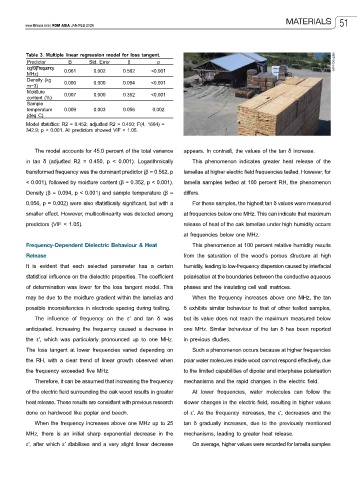
          Table 3. Multiple linear regression model for loss tangent.
          Predictor    B      Std. Error   β        p                                                         John Douglas
          log10(Frequency,
          MHz)        0.061     0.002    0.562    <0.001
          Density (kg   0.000   0.000    0.094    <0.001
          m−3)
          Moisture    0.007     0.000    0.352    <0.001
          content (%)
          Sample
          temperature   0.009   0.003    0.056     0.002
          (deg C)
          Model statistics: R2 = 0.452; adjusted R2 = 0.450; F(4, 1664) =
          342.9; p < 0.001. All predictors showed VIF < 1.05.


            The model accounts for 45.0 percent of the total variance   appears. In contrast, the values of the tan δ increase.
          in  tan  δ  (adjusted  R2  =  0.450,  p  <  0.001).  Logarithmically   This  phenomenon  indicates  greater  heat  release  of  the
          transformed frequency was the dominant predictor (β = 0.562, p   lamellae at higher electric field frequencies tested. However, for
          < 0.001), followed by moisture content (β = 0.352, p < 0.001).   lamella samples tested at 100 percent RH, the phenomenon
          Density (β = 0.094, p < 0.001) and sample temperature (β =   differs.
          0.056, p = 0.002) were also statistically significant, but with a   For these samples, the highest tan δ values were measured

          smaller effect. However, multicollinearity was detected among   at frequencies below one MHz. This can indicate that maximum
          predictors (VIF < 1.05).                           release of heat of the oak lamellae under high humidity occurs
                                                             at frequencies below one MHz.
          Frequency-Dependent Dielectric Behaviour & Heat       This phenomenon at 100 percent relative humidity results
          Release                                            from  the  saturation  of  the  wood’s  porous  structure  at  high
          It  is  evident  that  each  selected  parameter  has  a  certain   humidity, leading to low-frequency dispersion caused by interfacial
          statistical influence on the dielectric properties. The coefficient   polarisation at the boundaries between the conductive aqueous

          of  determination  was  lower  for  the  loss  tangent  model. This   phases and the insulating cell wall matrices.
          may be due to the moisture gradient within the lamellas and   When  the  frequency  increases  above  one  MHz,  the  tan
          possible inconsistencies in electrode spacing during testing.   δ  exhibits  similar  behaviour  to  that  of  other  tested  samples,
            The  influence  of  frequency  on  the  ε′  and  tan  δ  was   but  its  value  does  not  reach  the  maximum  measured  below
          anticipated.  Increasing  the  frequency  caused  a  decrease  in   one  MHz.  Similar  behaviour  of  the  tan  δ  has  been  reported
          the  ε′,  which  was  particularly  pronounced  up  to  one  MHz.   in previous studies.
          The  loss  tangent  at  lower  frequencies  varied  depending  on   Such a phenomenon occurs because at higher frequencies
          the  RH,  with  a  clear  trend  of  linear  growth  observed  when   polar water molecules inside wood cannot respond effectively, due
          the frequency exceeded five MHz.                   to the limited capabilities of dipolar and interphase polarisation

            Therefore, it can be assumed that increasing the frequency   mechanisms and the rapid changes in the electric field.
          of the electric field surrounding the oak wood results in greater   At  lower  frequencies,  water  molecules  can  follow  the
          heat release. These results are consistent with previous research   slower changes in the electric field, resulting in higher values
          done on hardwood like poplar and beech.            of  ε′. As  the  frequency  increases,  the  ε′,  decreases  and  the
            When the frequency increases above one MHz up to 25   tan  δ  gradually  increases,  due  to  the  previously  mentioned
          MHz,  there  is  an  initial  sharp  exponential  decrease  in  the   mechanisms, leading to greater heat release.
          ε′,  after  which  ε′  stabilises  and  a  very  slight  linear  decrease   On average, higher values were recorded for lamella samples

